What is a teru teru bozu?
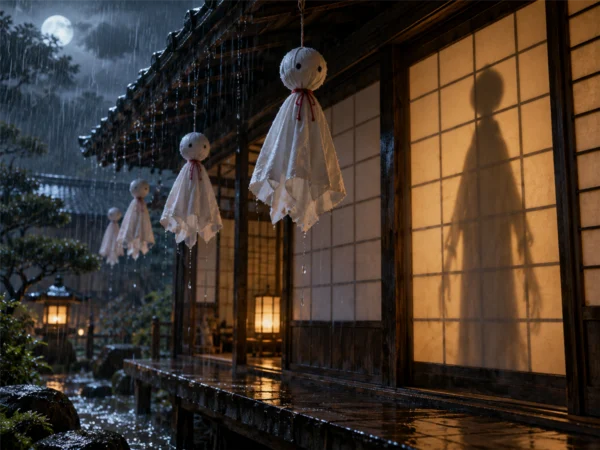
Teru teru bozu is a Japanese custom of hanging a doll made of white cloth or paper from the eaves or a window to wish for fine weather the next day. Already widespread in the Edo period, it is loved as a familiar charm that children make the day before a school trip or sports day.
In 1921, the children’s song “Teru Teru Bozu,” with words by Asahara Kyoson and music by Nakayama Shinpei, was published, and it is still widely sung today.
Is the third verse scary?
In the first and second verses, the singer asks the doll for good weather, promising it a bell or sweet sake if it clears up. In the third verse, however, the singer says that if it still rains and they are left crying, they will cut off the doll’s head. Because of the contrast with the sweet melody, people sometimes say “the teru teru bozu song is actually scary.”
Origin of the teru teru bozu and the rumors
The roots of the teru teru bozu are said to lie in China’s “Saoqing Niang,” a paper-cut doll of a girl holding a broom, hung to pray to heaven for clear skies when rain went on and on.
In Japan, a frightening story is also told: a monk prayed for fine weather, but the rain did not stop, so he was made to take responsibility and beheaded, and his head was wrapped in white cloth and hung up, which was the beginning. However, this is not based on any reliable record and is thought to be an urban legend born from the song’s third verse.