What is Toryanse?
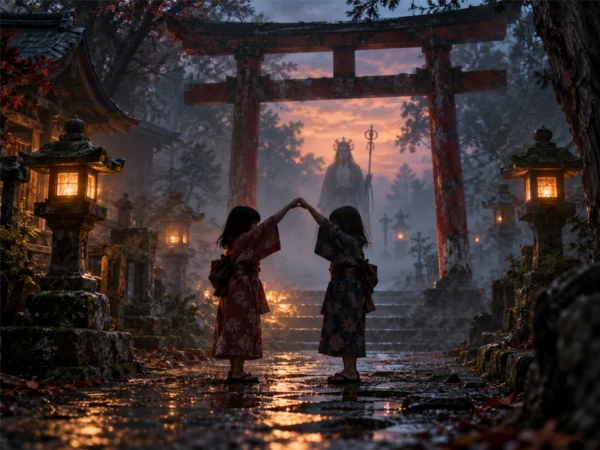
Toryanse is a children’s song sung since the Edo period. It is an exchange between a parent and child going to offer a charm for the child’s seventh-year celebration and the gatekeeper guarding the narrow path to a Tenjin shrine (a shrine to Sugawara no Michizane). It has been handed down with a game in which two children join hands to form a gate and the others pass under it singing.
In the Showa era it was also used as the melody at pedestrian crossings to signal a green light, making it familiar to many people.
Where Toryanse began
Miyoshino Shrine in Kawagoe, Saitama Prefecture, is known as the birthplace of Toryanse. Because the shrine stood within the grounds of Kawagoe Castle, ordinary people had to pass through the castle gate to visit it, and were strictly searched by the guards on the way back; this is said to be the origin of the song. A monument reading “birthplace of the children’s song” stands at the shrine. Another theory places its origin at Sugawara Shrine in Odawara, Kanagawa Prefecture.
The dark meanings of Toryanse
Because the song says that going is fine but coming back is scary, many dark meanings have been told. In the past, many children did not live to seven, and the seventh-year celebration was a ritual of thanks for growing up safely. From this came whispered theories that poor families took a child to the shrine to reduce the number of mouths to feed and came home without them, or that it is a song about offering a child as a human sacrifice to the gods.
Of course these theories have no solid basis, but the setting of a dim shrine path and an exchange with a gatekeeper gives the song a strange eeriness. For Tenjin, the god of learning, see also the legend of Sugawara no Michizane’s vengeful spirit.