Yamata no Orochi

ヤマタノオロチ

Divine & Mythical Beasts

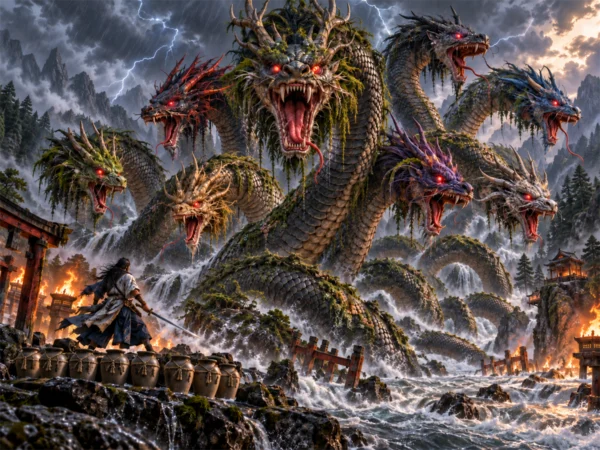
A gigantic serpent with eight heads and eight tails. Described in the Kojiki and Nihon Shoki, it was slain by the god Susanoo after being made drunk on sake, and the sword Kusanagi was found in its tail. It is the most famous monster of the Izumo myths.

Also known asYamata-no-Orochi, Eight-headed serpent, Orochi
Era / first recordedNara period (Kojiki and Nihon Shoki)
OriginJapan
Stats
Rarity
Danger
Reality
Fame

Originally written in Japanese. 日本語版を読む (the Japanese page also has rankings and comments).

What is Yamata no Orochi?

Yamata no Orochi is a gigantic serpent from Japanese mythology. It has eight heads and eight tails, eyes as red as winter cherries, and moss, cedars and cypress trees growing on its body; it is said to be so large that it stretches across eight valleys and eight hills. Described in the Kojiki and the Nihon Shoki, it is one of the most famous monsters in Japan.

Susanoo slays the serpent

After being banished from the heavens, the god Susanoo descended to the upper reaches of the Hii River in Izumo Province (present-day Shimane Prefecture), where he found an old couple weeping beside their daughter. Every year, they explained, Yamata no Orochi came and ate one of their daughters, and now their last daughter, Kushinadahime, was about to be eaten too. Susanoo had eight vats filled with strong sake, and when the serpent drank and fell into a drunken sleep, he cut it to pieces with his sword. Inside one of its tails he found a sword, which became Kusanagi no Tsurugi, one of the three sacred treasures of Japan.

What was the serpent really?

A well-known theory holds that Yamata no Orochi represents the Hii River and its tributaries, which flooded again and again and caused great suffering. Because a sword emerged from its tail, another theory links it to the iron-making that flourished in the region. In the Iwami Kagura dance theater of Shimane Prefecture, the serpent-slaying is performed as a thrilling piece called “Orochi.”


Yamata no Orochi: Legend & Sighting Locations

Please note Trespassing on private property or restricted areas is prohibited by law. Please be considerate of local residents.

Positions on the map are a rough guide to the area where a legend or sighting is set. Most pins are placed at representative points of a municipality or prefecture (outside Japan, a city position rounded to about 10 km, or the country), not at the exact place.
Municipality points: Geolonia address data (CC BY 4.0), based on the Address Base Registry (Digital Agency of Japan) / Country points: Natural Earth

Sources & References

  1. 古事記 (712)
  2. 日本書紀 (720)

Please note The contents of this site introduce legends, eyewitness accounts and theories; they do not guarantee that anything described is true. The stats are our own rough guide. Trespassing on private property or restricted areas is prohibited by law. Please be considerate of local residents.

Related Entries