Bake-danuki (Shapeshifting Tanuki)

化け狸

Yokai

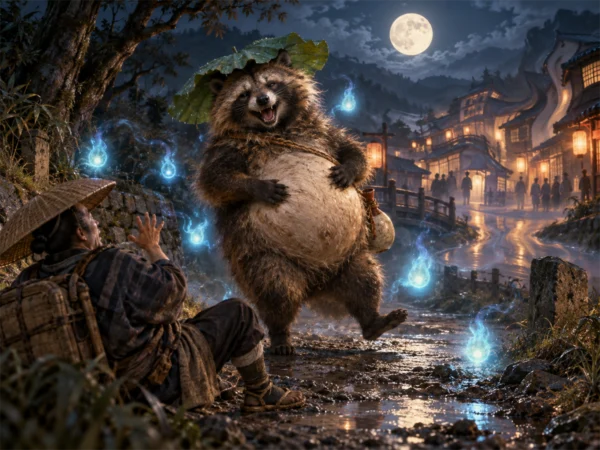
A tanuki (raccoon dog) yokai that tricks people and transforms into people and things. Legends of famous great tanuki abound in Shikoku and Sado, and it is beloved through folktales like Bunbuku Chagama and stories of tanuki drumming on their bellies.

Also known asTanuki, Bake-danuki, Danzaburo-danuki, Shibaemon-danuki, Bunbuku Chagama, Raccoon dog yokai
Era / first recordedAncient times onward
OriginJapan
Related people
Stats
Rarity
Danger
Reality
Fame

Originally written in Japanese. 日本語版を読む (the Japanese page also has rankings and comments).

What is a bake-danuki?

The bake-danuki is a tanuki (Japanese raccoon dog) yokai that bewitches people and changes into people and objects. Together with the fox, it is the classic “trickster animal” of Japan; there is even a saying that the fox has seven transformations and the tanuki eight. While fox stories are often frightening, tanuki stories tend to be comical and a little goofy.

Legends of famous great tanuki

Shikoku is especially rich in tanuki legends. In Tokushima Prefecture, the “Awa Tanuki War” tells of tanuki splitting into two factions and fighting a great battle. Another tradition says there are no foxes in Shikoku because the monk Kobo Daishi drove them out. Danzaburo-danuki of Sado (Niigata), Tasaburo-danuki of Yashima (Kagawa) and Shibaemon-danuki of Awaji Island (Hyogo) are known as Japan’s “three famous tanuki.”

Tanuki in folktales

“Bunbuku Chagama,” handed down at Morinji temple in Tatebayashi, Gunma Prefecture, is a famous folktale about a tanuki that turns into a tea kettle and performs tightrope tricks. At Shojoji temple in Kisarazu, Chiba Prefecture, a legend tells of tanuki drumming on their bellies on a moonlit night in a dance contest with the head priest, which inspired a well-known children’s song. Alongside the fox yokai, it is one of Japan’s most familiar tricksters.
Bake-danuki (Shapeshifting Tanuki): Legend & Sighting Locations

Please note Trespassing on private property or restricted areas is prohibited by law. Please be considerate of local residents.

Positions on the map are a rough guide to the area where a legend or sighting is set. Most pins are placed at representative points of a municipality or prefecture (outside Japan, a city position rounded to about 10 km, or the country), not at the exact place.
Municipality points: Geolonia address data (CC BY 4.0), based on the Address Base Registry (Digital Agency of Japan) / Country points: Natural Earth

Sources & References

  1. 画図百鬼夜行 (鳥山石燕, 1776)

Please note The contents of this site introduce legends, eyewitness accounts and theories; they do not guarantee that anything described is true. The stats are our own rough guide. Trespassing on private property or restricted areas is prohibited by law. Please be considerate of local residents.

Related Entries