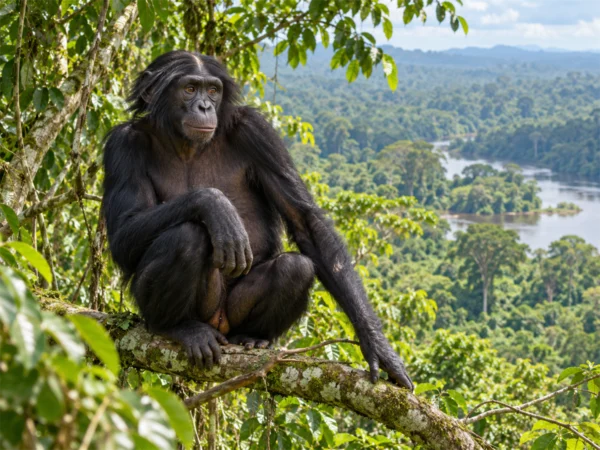
Was the bonobo an unknown ape?
The bonobo is an ape very similar to the chimpanzee. Because they look alike, it was not distinguished from the chimpanzee until the 20th century, and no one knew a different kind of ape existed. Among the great apes, it was the last to enter the world of science.
How it was discovered and confirmed
In 1929, the German researcher Ernst Schwarz examined a small skull kept in a Belgian museum and announced it as a new subspecies of chimpanzee. Then in 1933, the American researcher Harold Coolidge studied it in detail and concluded it was a separate species. Because it is somewhat smaller, it was once called the “pygmy chimpanzee.”
What we know today
Bonobos live only in the forests south of the Congo River in the Democratic Republic of the Congo. Compared with chimpanzees, they fight less and are known for many behaviors that keep relationships among group members peaceful. Japanese researchers have also carried out long-term field studies on site since the 1970s. Their population is small, and they are listed as endangered.