What is the Gaia hypothesis?
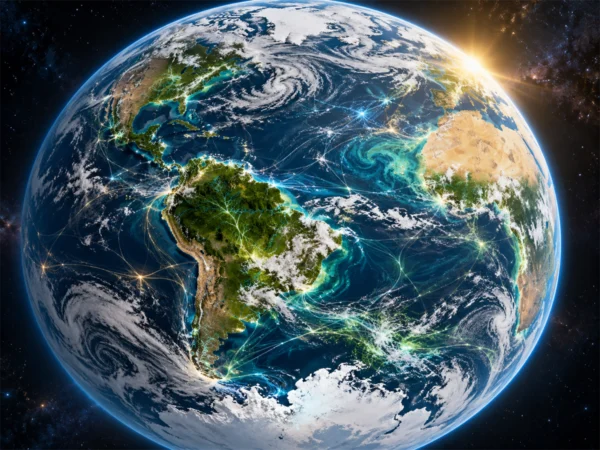
The Gaia hypothesis (Gaia theory) is the idea that living things on Earth and their environment, such as the air, oceans, soil and rocks, influence one another so that the whole Earth, like one giant living organism, maintains conditions that are favorable for life. It is named after Gaia, the earth goddess of Greek mythology (mother of the Titans).
Lovelock and the birth of the Gaia hypothesis
The Gaia hypothesis was proposed by the British scientist James Lovelock. In the 1960s, while involved in NASA’s Mars exploration program, Lovelock noticed that Mars’s atmosphere was chemically stable, while Earth’s atmosphere was in an unstable state with oxygen, methane and other gases mixed together. He then wondered whether Earth’s atmosphere was constantly being remade and maintained by the activity of living things.
Lovelock published the idea in the 1970s and developed it with the biologist Lynn Margulis. The name “Gaia” is said to have been suggested by Lovelock’s neighbor, the writer William Golding, known for the novel Lord of the Flies.
Between science and urban legend
When it was first published, the Gaia hypothesis was criticized by many scientists as making it seem “as if the Earth had a will.” Later, the view that living things strongly influence Earth’s atmosphere and climate developed into “Earth system science,” and it has become an important way of thinking about environmental problems such as global warming.
On the other hand, the Gaia hypothesis has also become linked with spiritual ideas and urban legends such as “the Earth is alive,” “the Earth has consciousness” and “if humanity destroys the environment, the Earth will eliminate humanity.” These stories need to be distinguished from Lovelock’s own claims. The image of the world as a single living thing, like Yggdrasil, the world tree of Norse myth, has long fascinated people.