What is a gargoyle?
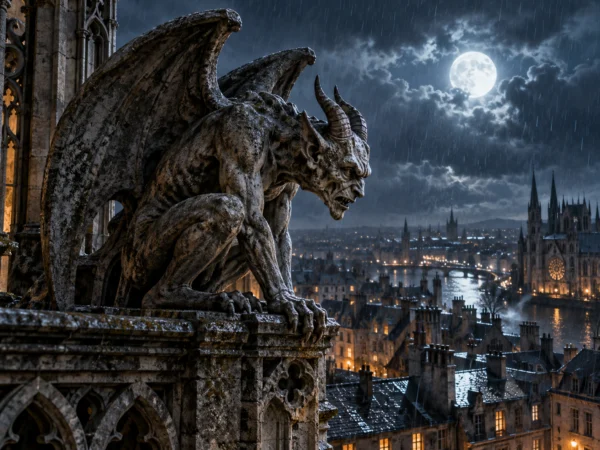
A gargoyle is a stone carving in the shape of a monster or animal attached to the roofs and walls of Gothic cathedrals and churches in Europe. Its original role was a “rain spout,” made to send rainwater from the roof gushing out of the monster’s mouth and protect the walls from water. The name comes from the French word “gargouille,” meaning throat, and is said to be related to the gurgling sound of water passing through a throat.
Monsters to ward off evil
There are several theories as to why frightening monster carvings were placed on cathedrals: to drive away evil spirits, or to show people that the world outside the church was the realm of evil. Strictly speaking, decorative monster carvings without a drainage function are distinguished as “grotesques” or “chimeras,” but in general they are all called gargoyles. The monster carvings of Notre-Dame Cathedral in Paris are especially famous.
The dragon Gargouille of Rouen
In the town of Rouen in northern France, there is a legend that around the 7th century, Bishop Saint Romanus defeated “Gargouille,” a dragon living in the Seine that caused floods and tormented the people. The dragon’s body was burned, but its fire-breathing head and neck did not burn, so they were placed on the wall of a church, and this, the story goes, was the beginning of gargoyles.
Stone monsters that move at night
In modern fantasy and games, gargoyles are depicted as monsters that pretend to be statues by day and spread their wings and come to life at night. Their devilish appearance overlaps with the images of the imp and demon.