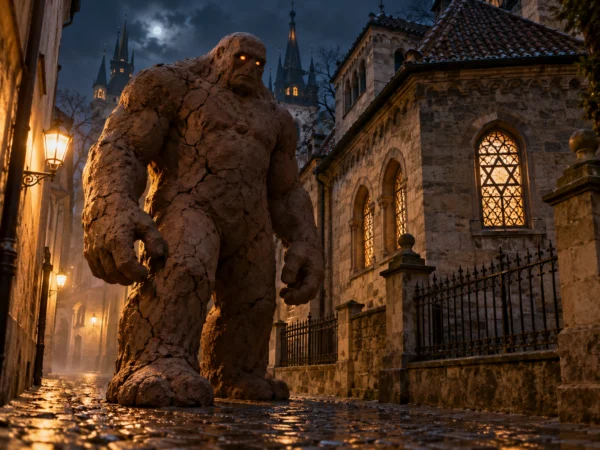
What is a golem?
A golem is a human-shaped being made by kneading mud or clay, found in Jewish tradition. The word comes from a Hebrew term meaning “something unfinished” or “a shapeless mass.” Given life by the name of God or the power of sacred letters, it does heavy work and other tasks exactly as its maker commands, but it is said to be unable to speak.
“Emeth” (truth) and “meth” (death)
A well-known tradition says that the Hebrew word “emeth” (truth) is written on the golem’s forehead; erasing its first letter leaves “meth” (death), and the golem stops moving and returns to earth. Another story says it is animated by a paper with the name of God placed in its mouth. This idea of the power of letters is closely tied to Kabbalah, Jewish mysticism.
The Golem of Prague
The most famous is the legend of Judah Loew ben Bezalel, a renowned rabbi (Jewish teacher) who lived in 16th-century Prague, today’s capital of Czechia. To protect the Jewish quarter from persecution, Rabbi Loew made a golem from the mud of the Vltava River, it is said. But the golem eventually went on a rampage, so the rabbi took away its life, and its body was hidden in the attic of Prague’s Old New Synagogue, the story goes.
However, the story is thought to have been linked to Rabbi Loew mainly from the 18th–19th centuries on.
Ancestor of robots and game monsters
The story of a golem, made by human hands that eventually slips out of control, shares its theme with Frankenstein and R.U.R., the play by the Czech writer Karel Capek that gave us the word “robot.” It is sometimes compared to the homunculus, the artificial human of alchemy. Today it is familiar as a rock or earth giant monster in fantasy RPGs.