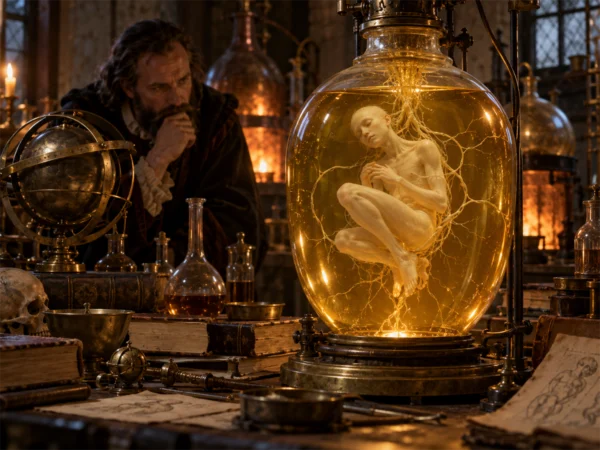
What is a homunculus?
A homunculus is a small human thought, in European alchemy, to be created artificially. The word means “little man” in Latin. Because it is born in a flask (alembic) and is said to be unable to live outside it, it is also called “the little man in the flask.”
Paracelsus and how to make a homunculus
How to make a homunculus is described in De Natura Rerum (On the Nature of Things), attributed to Paracelsus, the 16th-century Swiss-born physician and alchemist. According to it, if human semen is sealed in an alembic and kept warm in horse manure for 40 days, a transparent human-shaped thing appears; fed with human blood and raised at the same temperature for 40 weeks, it becomes a small human.
A homunculus made this way was said to be born possessing all knowledge. However, scholars have questioned whether the book was really written by Paracelsus himself. Paracelsus is also known for spreading the idea of the four elemental spirits (sylph, undine, salamander and gnome).
The homunculus in Goethe’s Faust
The homunculus was made famous by Part Two of the German writer Goethe’s play Faust (1832). The homunculus created in a flask through alchemy by Wagner, Faust’s assistant, has wisdom but no body; it travels in search of becoming truly real, and in the end shatters in the sea and dissolves into the source of life.
The homunculus today
As a symbol of humanity’s longing for and fear of creating life, the homunculus appears in many works of manga, anime and games. Its name also survives as a scientific term: in neuroscience, a human-shaped map showing which parts of the brain correspond to which parts of the body is called a “homunculus” (Penfield’s homunculus). Compare also the golem and Frankenstein.