What is Frankenstein?
Frankenstein; or, The Modern Prometheus is a novel published anonymously in 1818 by the English writer Mary Shelley. Its hero, Victor Frankenstein, is a young Swiss-born scientist who, seeking to unlock the secret of life, stitches together parts of corpses to create a new life. Because it depicts creating artificial life through science, it is often called the first science fiction novel.
Frankenstein is not the monster’s name
It is a common misunderstanding, but “Frankenstein” is the name of the scientist who made the monster, not the monster itself. In the novel the monster has no name and is called “the monster,” “the creature” and so on. Abandoned even by his creator Victor because of his hideous appearance and hunted by people, the creature grows lonely and bitter, and eventually takes revenge on Victor’s family and loved ones.
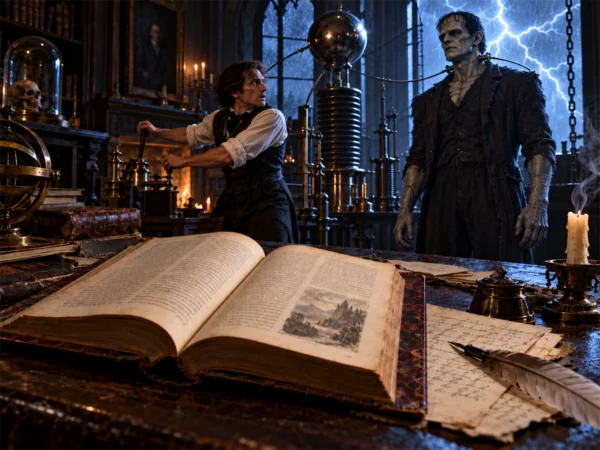
The famous image of the monster with a flat-topped head and bolts comes from the makeup worn by the actor Boris Karloff in the 1931 American film Frankenstein; it is not described in the original novel.
The ghost story contest at the Villa Diodati
The novel was born in the summer of 1816, the “Year Without a Summer,” when Europe suffered an unusually cold summer. Mary, then 18, was staying with the poet Percy Shelley, later her husband, at the Villa Diodati, the poet Byron’s villa on Lake Geneva in Switzerland. With rain keeping them indoors day after day, Byron proposed that “each of us write a ghost story,” and this was the story Mary began.
At the same gathering, Byron’s physician Polidori wrote the story The Vampyre, which greatly influenced later vampire literature. One evening’s game produced two monster stories.
What Frankenstein left behind
At the time, experiments in which electricity made a dead frog’s legs twitch (galvanism) were much talked about, and the hope and fear that science was closing in on the mystery of life are thought to lie behind the story. Its theme of the responsibility of humans who create life echoes the legend of the alchemical homunculus and is retold again and again in an age of advanced AI and life science.