What is the Codex Seraphinianus?
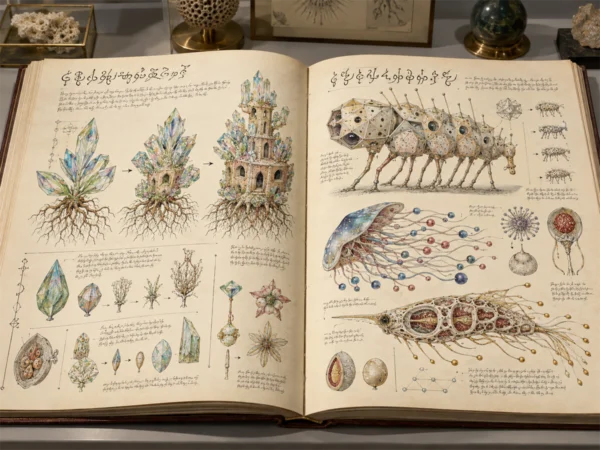
The Codex Seraphinianus is a book that the Italian architect and artist Luigi Serafini spent about two and a half years drawing in the late 1970s, published by an Italian publisher in 1981. It takes the form of an “encyclopedia” of a world that does not exist, and every page consists of a script invented by the author and colorful illustrations.
Strange illustrations
The book is divided into chapters on plants, animals, minerals, physics, machines, humans, history, writing, food, architecture and more. Its pages show one image after another that turns everyday common sense upside down: plants that turn into pens, fish flying through the sky, a man and woman embracing who gradually turn into a crocodile, and tools made by solidifying rainbows. The sequence of images, like surrealist paintings, leaves a strong impression on viewers.
Can the script be deciphered?
Because the script is arranged as regularly as a language, many people tried to decipher it from the time of publication. Although some results were achieved, such as working out the rules of its number system, the meaning of the text remained unreadable. Serafini himself later explained in talks and elsewhere that the script has no meaning, and that he wanted readers to experience the feeling of a child who cannot yet read looking at a book.
As a mysterious book written in an unknown script, it is compared with the 15th-century Voynich Manuscript and sometimes called “the modern Voynich Manuscript.” The first edition was an expensive limited edition, but it has since been reprinted in many countries and has fans around the world as an art book.