What is the Voynich Manuscript?
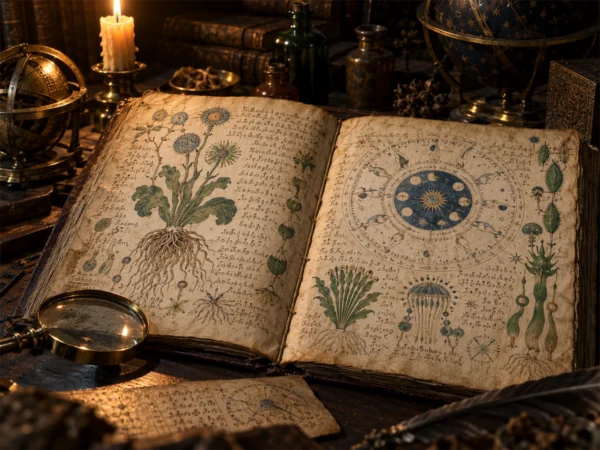
The Voynich Manuscript is a handwritten book written in an unknown script that matches no known language, accompanied by strange illustrations. It is held by the Beinecke Rare Book and Manuscript Library at Yale University in the United States as “MS 408.” About 240 vellum pages survive, and it has been called “the most mysterious book in the world.”
It is named after Wilfrid Voynich, a Polish-born antiquarian book dealer who acquired it in Italy in 1912. Radiocarbon dating carried out in 2009 showed that the vellum dates from around 1404–1438.
Contents and illustrations
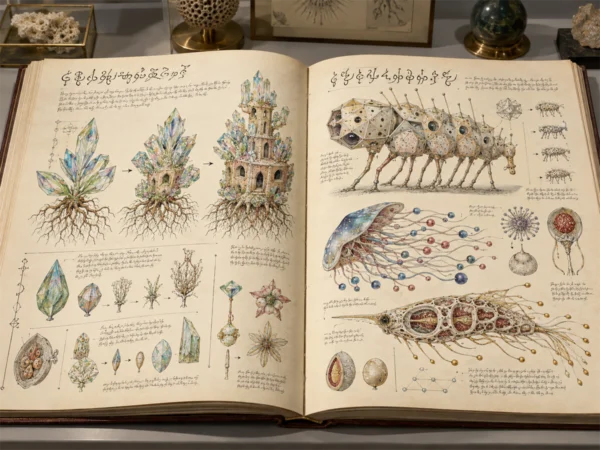
Based on its illustrations, the manuscript is divided into “herbal,” “astronomical/astrological,” “biological (women in pools),” “pharmaceutical” and “recipes” sections. The herbal section depicts flowers and roots that match no known plant, while the biological section shows naked women standing in pools and pipes filled with green or blue liquid.
The writing is a flowing cursive, and analysis has shown it has language-like regularities, such as repeated words, unlikely in random scribbling.
The manuscript’s history
According to a letter from 1665 (or 1666) found with the manuscript, the book was bought by the Holy Roman Emperor Rudolf II for 600 ducats, then passed through a scholar in Prague to the Jesuit polymath Athanasius Kircher. Its whereabouts were then unknown for more than 200 years until Voynich brought it back to light.
Attempts at decipherment
Many people, from World War II codebreakers and linguists to recent researchers using AI, have tried to decipher it, but no decipherment is widely accepted. Theories include a book written in cipher, one written in an extinct or artificial language, a forgery by the 16th-century alchemist Edward Kelley and others, and a work of meaningless characters. However, because the vellum dates from the early 15th century, a modern forgery is considered unlikely. It is often mentioned alongside other undeciphered books such as the Rohonc Codex.