What is the Rohonc Codex?
The Rohonc Codex is a handwritten book in an unknown script held by the Hungarian Academy of Sciences. It is named after the town of Rohonc (today Rechnitz in Burgenland, Austria), where the library of the Batthyany family, which once kept the book, was located. In Japanese it is also called the “Rechnitz manuscript” after the German place name. The Batthyany family donated it to the Hungarian Academy of Sciences in 1838.
Its script and illustrations
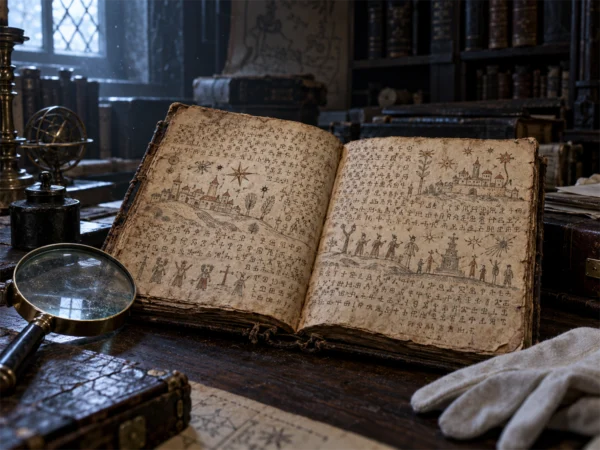
The codex is a small paper book whose 448 pages are filled with text that appears to be written from right to left. The number of different symbols runs into the hundreds, far more than an ordinary alphabet, so it is thought that it may include syllabic or ideographic characters.
The book has more than 80 illustrations, including pictures apparently related to the Bible, such as crosses and scenes from the Passion of Christ, as well as crescent moons, suns and pagan symbols. The mixture of Christian, Islamic and pagan elements also deepens the mystery. The paper bears a watermark found on Italian paper of the early 16th century.
Attempts at decipherment and the forgery theory
Various decipherments have been published, including theories that it is a prayer book written in Old Hungarian script, that it is written in ancient Dacian (an old language of the region of today’s Romania), and that it is related to the Brahmi script of India, but none has been widely accepted.
There is also a persistent theory that it is a forgery made by Samuel Literati Nemes, a 19th-century Hungarian antiquarian. He was known for making fake ancient documents, and the timing of the codex’s discovery overlaps with his period of activity. As an undeciphered book, it is often introduced alongside the Voynich Manuscript.