What is the Book of the Dead?
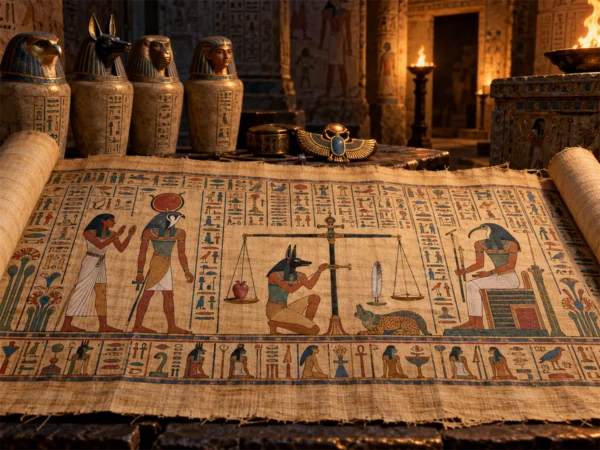
The Book of the Dead is a collection of spells and prayers for traveling through the underworld, placed in tombs with the dead in ancient Egypt. It came into wide use at the start of the New Kingdom (around the 16th century BC) and continued to be made for about 1,500 years, until the Ptolemaic period. There were about 200 spells, and those chosen for each person were written on a papyrus scroll with beautiful illustrations.
Its original ancient Egyptian title was “The Book of Coming Forth by Day.” The name “Book of the Dead” spread after the 19th-century German Egyptologist Lepsius gave it that name. The “Papyrus of Ani” in the British Museum is one of the most famous copies.
The weighing of the heart and Osiris’s judgment
The best-known scene in the Book of the Dead is the “weighing of the heart” in Chapter 125. The dead person is brought before Osiris, king of the underworld, and swears before the gods that they did no wrong in life. Then Anubis, the jackal-headed god, places the dead person’s heart on one side of a scale and the feather of Maat, goddess of truth, on the other, and Thoth, the ibis-headed god of wisdom, records the result.
If the heart balanced the feather, the dead person was welcomed into the paradise of the “Field of Reeds.” But if the heart was heavy with sin, it was eaten by Ammit, a monster with the head of a crocodile, the body of a lion and the hindquarters of a hippopotamus, and the person suffered a second death.
The hopes in the Book of the Dead
The Book of the Dead contains wisdom for surviving the afterlife safely: how to answer when the gatekeepers of the underworld ask your name, spells to drive away snakes and monsters, and a spell to make substitute figures (shabti) do your farm work in the afterlife. Like the ancient Egyptians’ devotion to making mummies, the Book of the Dead was born from a strong wish for eternal life.
Tibetan Buddhism also has a text called the “Tibetan Book of the Dead” (Bardo Thodol), and in Japan there is Orikuchi Shinobu’s novel Shisha no Sho (The Book of the Dead), but both are different from the Egyptian Book of the Dead. Another well-known symbol from ancient Egypt is the ouroboros, the snake biting its own tail.