What is the Ripley Scroll?
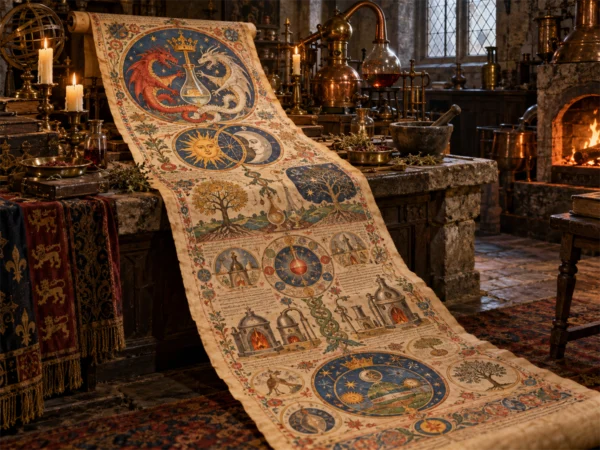
The Ripley Scroll is a scroll that shows how to make the philosopher’s stone, the great secret of alchemy, in symbolic pictures and verses. Long ones reach nearly 6 meters, and about twenty copies made in the 16th–17th centuries survive in the British Library, American libraries and elsewhere.
It is named after George Ripley, a 15th-century English cleric and alchemist. Ripley is known for his alchemical poem The Compound of Alchemy, but the scroll itself is thought to have been made after his death, borrowing his fame.
What the Ripley Scroll depicts
At the top of the scroll is an alchemist holding a flask; below him follow the sun and moon, several dragons and serpents, a toad and a bird called the “Bird of Hermes,” along with verses. These are said to express the alchemical process of dissolving, rotting, purifying and recombining matter through metaphors of living things and heavenly bodies.
In alchemy, such symbolic pictures (emblems) were used to pass secret knowledge only to a select few. Like the ouroboros, the serpent biting its tail, and the homunculus made in a flask, it is a document that conveys the mystical world of alchemy today.
Alchemy and the philosopher’s stone
The philosopher’s stone was said to be the ultimate substance, turning ordinary metals into gold and becoming the elixir of immortality. In Europe from the Middle Ages to early modern times, many alchemists sought to make it. Alchemy is often seen as superstition, but its accumulated experiments in heating, distilling and separating substances also led to the later development of chemistry.