What is the Codex Gigas?
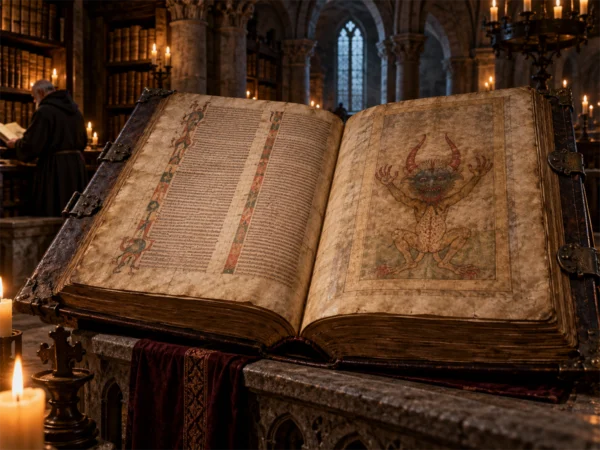
The Codex Gigas is a huge handwritten book thought to have been made in the early 13th century at a Benedictine monastery in Podlazice, Bohemia (today’s Czech Republic). “Gigas” means “giant” in Latin. It is about 92 cm tall and 50 cm wide and weighs about 75 kg, making it one of the largest surviving medieval European manuscripts. It is now held by the National Library of Sweden in Stockholm.
Why it is called the Devil’s Bible
The Codex Gigas is called the “Devil’s Bible” because a whole page is filled with a large picture of a crouching devil with horns, sharp claws and a red tongue sticking out. The facing page shows the Heavenly City (the kingdom of God), and the pair is thought to contrast heaven and hell.
According to legend, a monk who had broken his vows and was to be punished by being walled up alive swore to “write in one night a book that would glorify the monastery forever.” But when midnight came and it seemed he would never finish, he sold his soul to the devil to complete the book, and drew the devil’s portrait in it as thanks.
What the Codex Gigas contains
Its actual contents gather into one volume the Bible in Latin (Old and New Testaments), the Antiquities of the Jews by the Jewish historian Josephus, the encyclopedia Etymologies by Isidore of Seville, a chronicle of Bohemia, medical texts, exorcism spells, a calendar and more, making it a kind of summary of the knowledge of the time.
Because the handwriting appears to be almost entirely by one hand, researchers estimate that a single scribe may have spent more than 20 years writing it. The legend of writing it in one night may reflect just how enormous a task it was.
Its history
After moving between monasteries in Bohemia, the Codex Gigas was kept in Prague in the collection of Holy Roman Emperor Rudolf II. In 1648, at the end of the Thirty Years’ War, Swedish troops took it as war booty when they occupied Prague, and it has remained in Sweden ever since. In 2007 it briefly returned to Prague for an exhibition, drawing great attention. Another book said to have passed through Rudolf II’s hands is the Voynich Manuscript.