What is the Popol Vuh?
The Popol Vuh is a book collecting the myths and history of the K’iche’, a Maya people living in the highlands of Guatemala in Central America. The title is translated from K’iche’ as “Book of the Community” or “Book of the Council.” It is thought to have been written down in the K’iche’ language using the Latin alphabet by K’iche’ people in the mid-16th century, after the Spanish conquest.
The original was lost, but in the early 18th century, Francisco Ximenez, a Dominican friar working as a missionary in Chichicastenango, Guatemala, copied it and added a Spanish translation, and this manuscript survived. It is now held by the Newberry Library in Chicago.
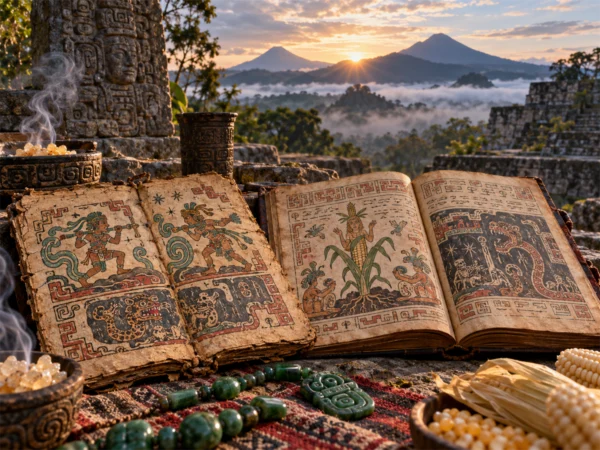
Humans were made from maize
The first part of the Popol Vuh is the story of the creation of the world. After making the earth, mountains and animals, the gods tried to make humans as beings who would praise them. First they made them from mud, but they crumbled and could not keep their shape. The humans they next made from wood had no hearts and did not revere the gods, so they were destroyed in a great flood, and the survivors became monkeys, it is said. Finally, humans kneaded from white and yellow maize at last became the beings the gods wished for. It vividly expresses the worldview of the Maya, whose staple food was maize.
The hero twins and the underworld Xibalba
The central story of the Popol Vuh is the adventure of the hero twins Hunahpu and Xbalanque. Summoned by the gods of Xibalba, the underworld, who had killed their fathers, the twins get through terrible trials such as the “Dark House,” the “Razor House” and the “Jaguar House” with their wits, and face the gods in the Maya ball game. Having finally defeated the gods, the twins rise into the sky and become the sun and moon, the story says.
The latter part of the book is history, recording the journeys of the K’iche’ ancestors and the lineage of their kings. The Popol Vuh is considered the most important source for Maya mythology and is treasured in Guatemala as a book representing the nation.