What is the Shroud of Turin?
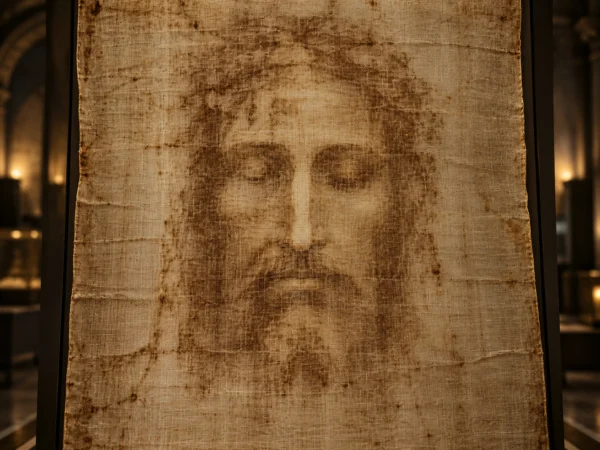
The Shroud of Turin is a linen cloth about 4.4 m long and 1.1 m wide kept in the cathedral of Turin in northern Italy. On the cloth, the front and back of a bearded man’s body appear faintly in brown. There are marks like wounds on the wrists, feet, side and forehead, and it has been believed to be the burial cloth (shroud) that wrapped the body of Jesus Christ, who died on the cross.
A face revealed in a photo negative
In 1898, the photographer who first photographed the cloth was astonished when he saw the developed negative (an image with light and dark reversed). The man’s face and body, vague on the cloth itself, emerged in the negative as a clear, three-dimensional figure. This meant that the image on the cloth itself had the qualities of a photographic negative. This became the start of the attention given to the shroud’s great mystery.
The 1988 dating
In 1988, three research institutions in Britain, the United States and Switzerland examined small pieces of the cloth using radiocarbon dating. They announced that the cloth was made in the Middle Ages, between about 1260 and 1390. The shroud also first appears in records in 1350s France, which fits the date well.
The remaining mystery
On the other hand, some argue that the pieces tested came from a part repaired in a later period. Also, almost no traces of paint have been found, and it is still not clear how such an image was formed. The Catholic Church makes no judgment on whether it is genuine and treasures it as an object of devotion. A list of the world’s out-of-place artifacts is on the OOPArts page.