What is the Meister print?
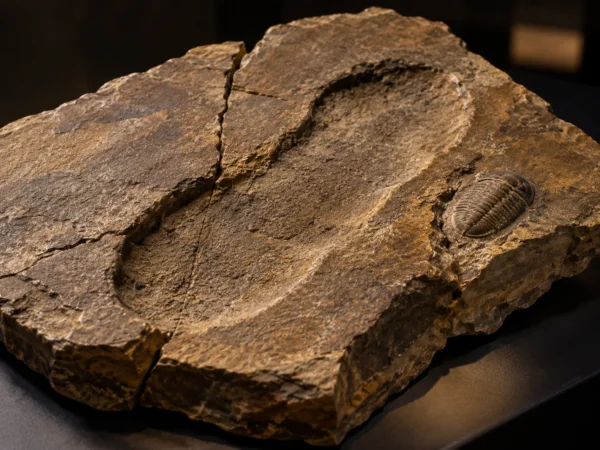
The “trilobite footprint” is a fossil said to have been found in 1968 at Antelope Spring, a trilobite fossil site in Utah, by a fossil collector named William Meister. It is also called the “Meister print” after its finder.
When he split a rock, a hollow about 26 cm long appeared, shaped as if stepped on by a sandal or shoe with a heel, with small trilobite fossils inside the hollow as if crushed underfoot, it is said.
Why it is called an OOPArt
The rock dates from the Cambrian period, about 500 million years ago. Trilobites were arthropods living in Paleozoic seas, and went extinct about 250 million years ago. If this were really a human footprint, humans would have lived alongside trilobites, meaning shoe-wearing people existed long before the age of dinosaurs. For this reason it was promoted by supporters of creationism and others as evidence against evolution.
How researchers see it
Geologists think the “footprint” is a spall, a mark left where the rock naturally split and flaked off. The shale in the area splits easily along thin layers and can form sandal-shaped hollows. A trail of footprints would alternate right and left, but no further prints have been found. It has also been pointed out that there is no raised mud around it, which a footstep would have made. Read also about the Paluxy “man tracks”. Famous OOPArts are listed on the OOPArts page.