Okiku Doll

お菊人形

Mysteries & Phenomena

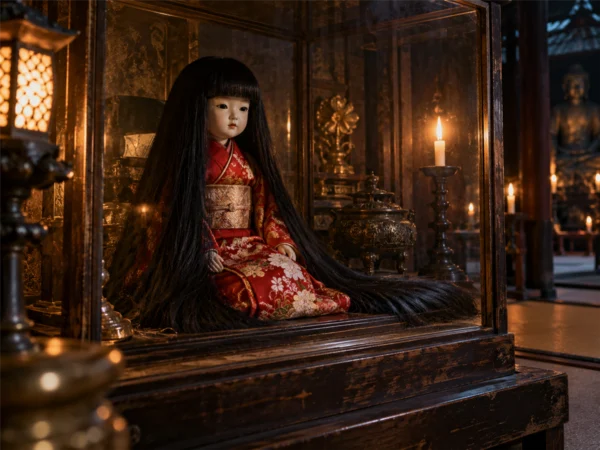
A Japanese doll kept at Mannenji Temple in Iwamizawa, Hokkaido, whose hair is said to grow. It belonged to Kikuko, a little girl who died young, and after her death the doll's bobbed hair began to grow, it is said. It is one of the most famous mysterious dolls in Japan.

Also known asOkiku doll, The doll whose hair grows, Okiku of Mannenji
Era / first recordedTaisho era
OriginJapan (Hokkaido)
Stats
Rarity
Danger
Reality
Fame

Originally written in Japanese. 日本語版を読む (the Japanese page also has rankings and comments).

What is the Okiku doll?

The Okiku doll is a Japanese doll about 40 cm tall enshrined at Mannenji Temple in Iwamizawa, Hokkaido. Known as “the doll whose hair grows,” it has been featured many times on television and in magazines and is one of the most famous mysterious dolls in Japan.

The legend of the Okiku doll

According to the temple’s story, in the Taisho era a young man bought a Japanese doll with bobbed hair at an exposition in Sapporo for his little sister Kikuko. Kikuko loved the doll dearly and always kept it by her side, but she died of illness at the age of three.

Her family placed the doll in the household Buddhist altar together with her ashes, called it “Okiku doll” and treasured it. After a while, however, the doll’s bobbed hair is said to have begun to grow little by little. The family believed Kikuko’s soul had entered the doll, and it was later entrusted to Mannenji Temple to be memorialized.

The mystery of the doll’s hair

The doll’s hair is said to have grown to around its shoulders, and the temple is also said to trim it regularly. One explanation is that the human hair used for the doll gradually slipped out from where it had been folded in when it was made.

Whatever the truth, the Okiku doll is still carefully memorialized along with her family’s love for the girl who died. Mannenji is a temple, so please be quiet and respectful if you visit.

Okiku Doll: Legend & Sighting Locations

Please note Trespassing on private property or restricted areas is prohibited by law. Please be considerate of local residents.

Positions on the map are a rough guide to the area where a legend or sighting is set. Most pins are placed at representative points of a municipality or prefecture (outside Japan, a city position rounded to about 10 km, or the country), not at the exact place.
Municipality points: Geolonia address data (CC BY 4.0), based on the Address Base Registry (Digital Agency of Japan) / Country points: Natural Earth

Please note The contents of this site introduce legends, eyewitness accounts and theories; they do not guarantee that anything described is true. The stats are our own rough guide. Trespassing on private property or restricted areas is prohibited by law. Please be considerate of local residents.

Related Entries