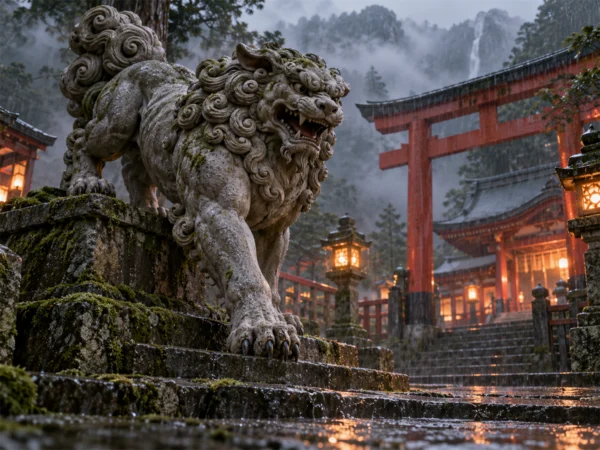
What are komainu?
Komainu are statues of imaginary animals resembling lions or dogs, placed in pairs on the left and right of the approach to a shrine or in front of its main hall. They are thought to be guardian beasts that drive away evil and protect the sacred grounds. They are sometimes placed at temple gates too, and they are relatives of the Okinawan shisa.
Meaning of komainu: “a” and “un”
Most komainu come in a pair: the open-mouthed agyo and the closed-mouthed ungyo. “A” is the first sound of the Sanskrit alphabet and “un” the last, so together they are said to represent “the beginning and end of all things,” or “the whole universe.” The Japanese expression a-un no kokyu, for two people perfectly in tune, also comes from this.
Originally, the open-mouthed statue on the right (as you face them) was a hornless “shishi” (lion), and the closed-mouthed one on the left was a “komainu” with a single horn on its head; together they were called “shishi-komainu.” Later the distinction blurred, and both came to be called komainu.
Origin and history of komainu
The roots of komainu are thought to be the lion statues placed in the ancient Middle East and India to protect kings and gods. These became lion statues in China and reached Japan via the Korean Peninsula. One theory says koma refers to Goguryeo (Koma), that is, something that came from abroad.
In the Heian period, wooden shishi and komainu were used at the imperial palace as weights for curtain stands and folding screens, and from around the Kamakura period they began to be placed at shrines. Outdoor stone komainu spread in the Edo period; because stonemasons in each region carved their own distinctive versions, their expressions and forms differ greatly from shrine to shrine.
All kinds of komainu
At some shrines, animals other than dogs play the role of komainu: foxes at Inari shrines, oxen at Tenmangu shrines, wolves at Mitsumine Shrine and others, monkeys at Hie Shrine and deer at Kasuga Taisha, called “koma-gitsune” (fox komainu), “koma-okami” (wolf komainu) and so on. “Komainu tours” in search of unusual statues, such as komainu holding cubs or doing handstands, are also popular.