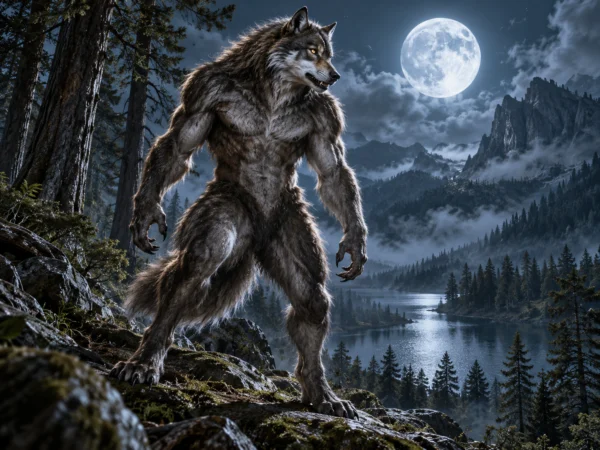
What is a werewolf?
A werewolf is a monster of European folklore, a human who changes into a wolf or a creature between wolf and human. It transforms on full moon nights, loses its reason and attacks people and livestock. The “were” in “werewolf” means “man” in Old English. A human turning into a wolf is called lycanthropy, and in France the creature is called the “loup-garou.”
Ancient werewolf legends
Stories of humans turning into wolves are old. In Greek mythology, Lycaon, king of Arcadia, was turned into a wolf as punishment for trying to feed human flesh to the god Zeus. A novel by the Roman writer Petronius also tells of a soldier who turns into a wolf on a full moon night. Norse mythology, too, has traditions of warriors who wore wolf skins and fought like beasts.
Werewolf trials and the Beast of Gevaudan
In 16th–17th-century Europe, as with the witch hunts, some people were accused of being “werewolves,” tried and executed. The 1589 trial of Peter Stumpp in Germany is well known. In 18th-century France, an unidentified beast attacked many people in the “Beast of Gevaudan” affair, which was linked with werewolf legends.
The full moon and silver bullets
The ideas that werewolves “transform at the full moon” and “can only be killed by silver bullets” have precursors in old folklore, but became widely established especially through 19th- and 20th-century novels and films. For the relationship between the full moon and the human mind, see also the lunar effect.
Along with the vampire and Frankenstein‘s monster, the werewolf is one of the “big three monsters” and a classic Halloween costume. The “Werewolf” party game, in which players find werewolves hidden among villagers through discussion, is also hugely popular.