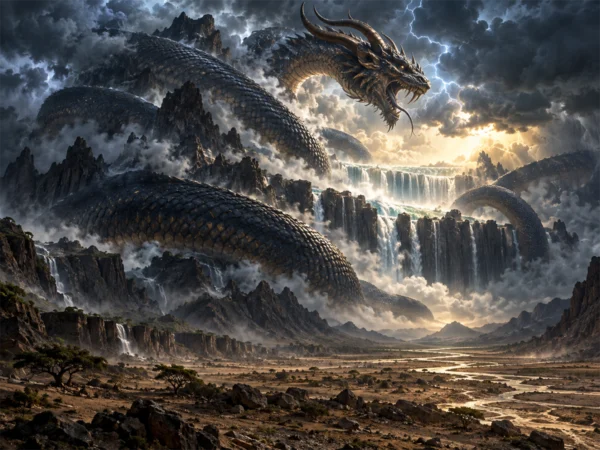
What is Vritra?
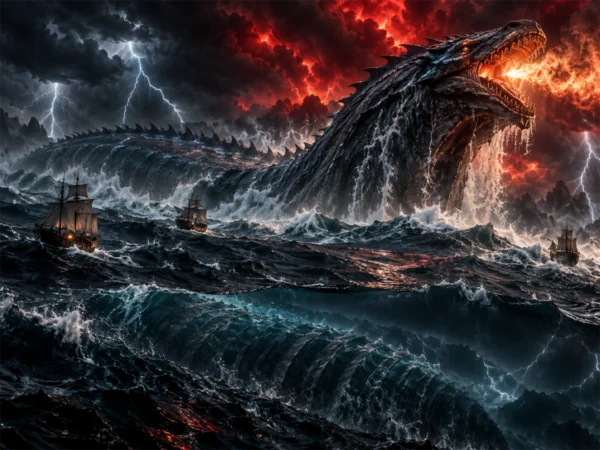
Vritra is a demon in the form of a giant serpent or dragon in the Rigveda, the oldest sacred text of ancient India. Its name is said to mean “the one who covers” or “the obstructer” in Sanskrit, and it is also considered one of the asuras, demons who opposed the gods.
The battle of Indra and Vritra
Vritra coiled on a mountain and dammed up the waters of the world’s rivers and rains, so the earth suffered a terrible drought. Then Indra, king of the gods and god of thunder, gained strength by drinking the divine drink soma and struck Vritra down with the vajra (thunderbolt) made by Tvashtri, the god of crafts, releasing the trapped waters.
For this deed, Indra was praised as “Vritrahan,” slayer of Vritra. The myth is also interpreted as representing the natural phenomenon of monsoon rains falling after the dry season and the rivers beginning to flow.
Vritra in later ages
In later times, the story of Vritra was retold in many ways. In the epic the Mahabharata and the Puranas, Vritra is a being created by Tvashtri to avenge his son, and there is a story that Indra, exploiting a promise that Vritra could not be killed “by anything dry or wet, by day or by night,” slew him at dusk with sea foam.
Vritra as a dragon-slaying myth
Stories of a hero god slaying a great serpent that threatens the waters or the order of the world are found all over the world, such as Thor and Jormungandr in Norse myth and Susanoo and Yamata no Orochi in Japanese myth. The slaying of Vritra is one of the oldest examples and is often discussed in comparative mythology. Among the serpents of Indian myth, it stands in contrast to Ananta and the nagas, who serve the gods.