What is Leviathan?
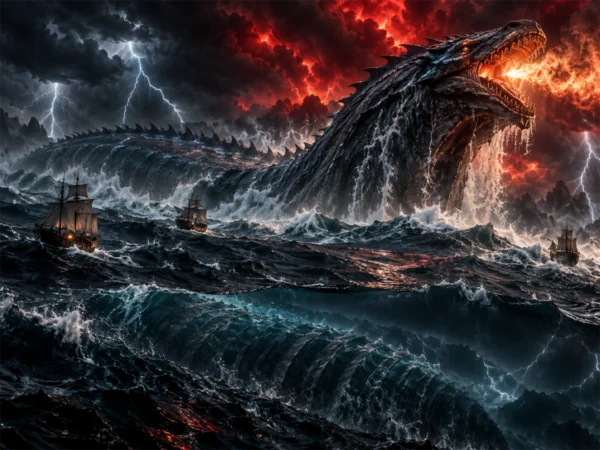
Leviathan is a giant sea monster in the Old Testament. Its name is said to mean “that which coils” in Hebrew, and it has been imagined as a serpent, a dragon or a huge crocodile. Along with Behemoth, the monster of the land, and Ziz, the giant bird of the sky, it is considered one of the giant creatures God created.
Leviathan in the Old Testament
Chapter 41 of the Book of Job describes Leviathan in detail. Its scales are as hard as rows of shields, no sword, spear or arrow can pierce it, fire comes from its mouth and smoke from its nostrils, and nothing on earth is its equal. Here it shows the greatness of God’s creation, which humans can never control.
In the Book of Isaiah, on the other hand, it appears as “the fleeing serpent” and “the twisting serpent,” a monster of chaos that God will strike down with his sword at the end of days. Behind this is thought to lie the influence of ancient Near Eastern myths, such as Mesopotamia’s Tiamat and Lotan, the sea monster of Canaanite myth.
Leviathan as a demon
In medieval Christianity, Leviathan was counted among the demons and was sometimes assigned to envy among the seven deadly sins. There are also paintings showing the mouth of hell as Leviathan with its jaws wide open.
In 1651, the English philosopher Thomas Hobbes wrote the work of political philosophy Leviathan, comparing a powerful state to this monster. Today it is also familiar in games and fantasy as a powerful water summon or sea dragon. As a giant sea monster, it is often compared with the Kraken and Jormungandr of the North.