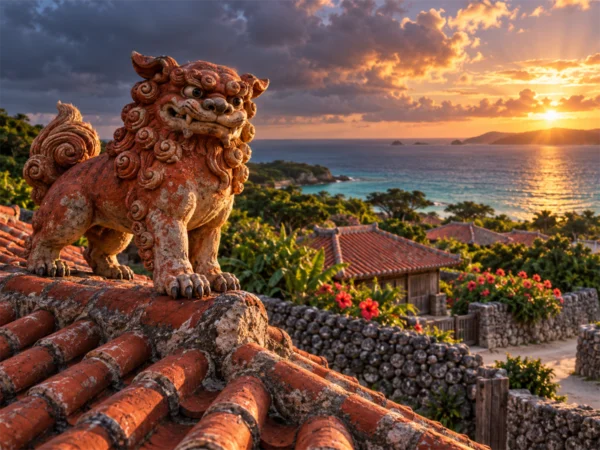
What is a shisa?
A shisa is a lion statue placed on the roofs and gateposts of houses and at the entrances of villages in Okinawa Prefecture. The name comes from the Okinawan pronunciation of shishi (lion), and shisa have been treasured as charms that drive away misfortunes such as evil spirits and fire. Like the komainu at shrines on the Japanese mainland, they are thought to have their roots in Chinese lion statues.
Meaning of the shisa: male and female
Today shisa are often placed in pairs, one with its mouth open and one with its mouth closed. The open-mouthed one is said to be male and to invite good fortune in, while the closed-mouthed one is female and keeps good fortune from escaping, or keeps misfortune out. Which goes on which side varies by household and region.
Originally they were often placed singly, and the custom of placing them in pairs is said to show the influence of the mainland komainu.
History and types of shisa
Lion statues are thought to have come to the Ryukyu Kingdom from China around the 13th–15th centuries. At first they were placed at royal palaces, castles (gusuku), temples and royal tombs, and later “village shisa” (mura-shisa) were made to guard the entrances of villages. The “Great Stone Lion of Tomori” in Yaese, made in 1689 to protect against fire, is said to be the oldest surviving village shisa.
When ordinary houses were allowed tiled roofs in the Meiji era, tile makers began making shisa from leftover tiles and plaster and setting them on roofs. These “roof shisa” have become a symbol of the Okinawan townscape.
Shisa today
Shisa are a classic Okinawan souvenir, and workshops for painting or making shisa from pottery (yachimun) or plaster are popular. Together with the Okinawan yokai kijimuna, the shisa is loved as a symbol of Okinawa.