What is a cyclops?
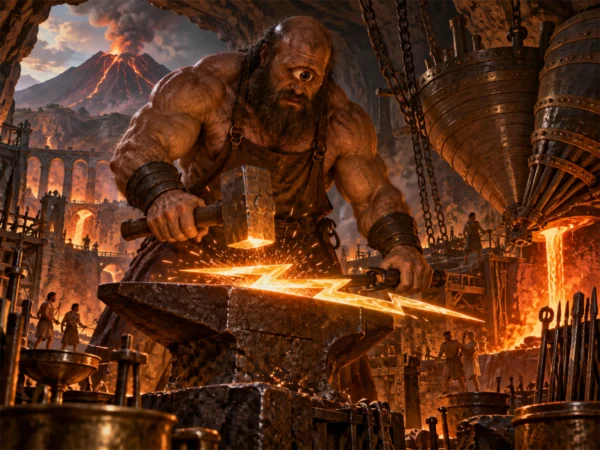
The Cyclopes (Greek Kyklopes) are giants in Greek mythology with only one round eye in the middle of their foreheads. The name means “round eye.” Myths tell of two kinds of cyclops: master smiths who made weapons for the gods, and violent man-eating giants living on an island.
The smiths who made Zeus’s thunderbolts
In Hesiod’s Theogony, the Cyclopes are children of Uranus and Gaia, three brothers named Brontes (thunder), Steropes (lightning) and Arges (bright). Imprisoned deep in the earth by their father, they were freed by Zeus during the war against the Titans, and in gratitude they made Zeus’s thunderbolt, Poseidon’s trident and Hades’s helmet of invisibility.
Odysseus and Polyphemus
In Homer’s epic the Odyssey, on the way home from the Trojan War, the hero Odysseus and his men are trapped in the cave of Polyphemus, a cyclops and son of the sea god Poseidon, who eats his companions one after another.
Odysseus got Polyphemus drunk on wine and told him his name was “Outis” (Nobody). Then, while the giant slept, he drove a burning stake into his eye. When the other giants came running at his screams and asked who had done it, Polyphemus answered, “Nobody did it,” so no one came to help him.
Were cyclopes really elephant skulls?
Small elephants (dwarf elephants) once lived on the islands of the Mediterranean, and fossils of their skulls have been found. An elephant skull has one large opening in the center for the trunk, and one theory suggests that ancient people who saw them took them for the skulls of one-eyed giants. Also, the walls of huge stones at Mycenae and elsewhere are called “Cyclopean masonry” because they are too large to have been stacked by humans.