Who are the Gigantes?
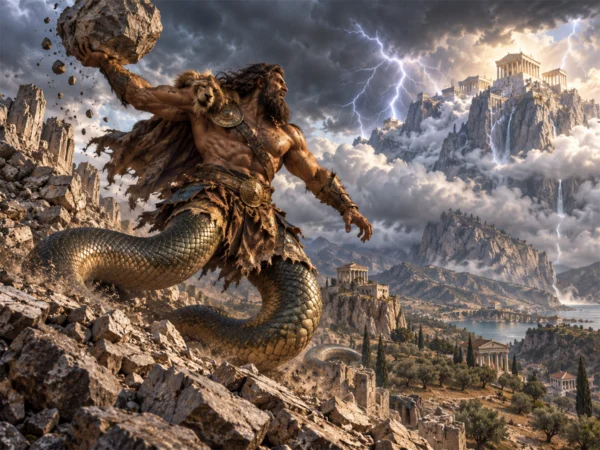
The Gigantes (singular Gigas) are a race of giants in Greek mythology. When the sky god Uranus was wounded by Cronus, Gaia, goddess of the earth, is said to have given birth to them from the blood that fell on the ground. They are depicted as armed warriors with spears, or with the lower bodies of great serpents. The English words “giant” and “gigantic” come from gigas.
The Gigantomachy
Angered that her children the Titans had been imprisoned deep in the earth by Zeus, Gaia urged the Gigantes to wage war on the Olympian gods. This is called the “Gigantomachy.” The giants piled up mountains to reach the heavens and tormented the gods by hurling rocks and burning trees.
However, there was a prophecy that “the giants cannot be defeated by the power of the gods alone; human help is needed.” So Zeus summoned the hero Heracles, his son by a human woman, and with the help of Heracles’s bow and arrows he struck down the giants.
Volcanoes and the Gigantes
The giant Enceladus was crushed beneath the island of Sicily, thrown at him by the goddess Athena, and is said to still be struggling under Mount Etna. Volcanic eruptions and earthquakes were thought to be caused by giants buried deep in the earth thrashing about.
The Gigantomachy was a popular subject in ancient Greece, and the reliefs of the Great Altar of Pergamon in Turkey (now in the Pergamon Museum in Berlin, Germany) show a fierce battle between gods and giants. Among giant myths, they are often compared with Ymir of Norse myth and the Nephilim of the Old Testament.