Nekomata

猫又

Yokai

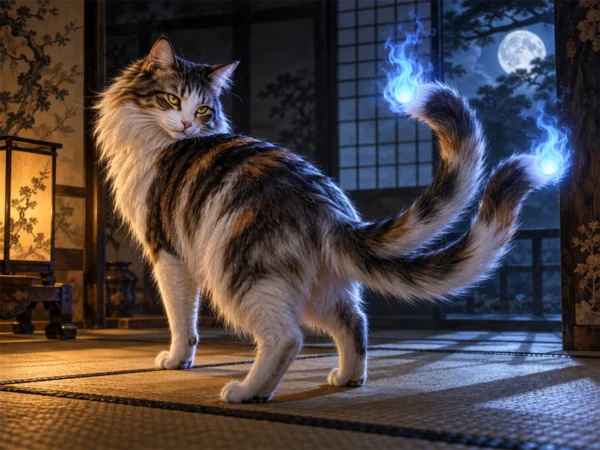
A yokai said to be a cat that has lived so long that its tail has split in two. It appears in the Kamakura-period classic Essays in Idleness, and is described both as a wild beast of the mountains and as a pet cat that transforms.

Also known asNeko-mata, Two-tailed cat, Forked-tail cat
Era / first recordedKamakura period
OriginJapan
Related people
Stats
Rarity
Danger
Reality
Fame

Originally written in Japanese. 日本語版を読む (the Japanese page also has rankings and comments).

What is a nekomata?

The nekomata is said to be an old cat that has turned into a yokai. Its most distinctive feature is a tail split into two, and it is said to speak human words, take human form and even dance. Edo-period yokai paintings show it as a cat with two tails.

The nekomata in the classics

Yoshida Kenko’s Essays in Idleness, written at the end of the Kamakura period, mentions a rumor that “deep in the mountains there is a thing called a nekomata that eats people.” In the story, a priest walking home at night is sure he has been attacked by a nekomata and tumbles into a river, only to find it was his own dog jumping on him in greeting. A Kamakura-period diary also records a beast believed to be a nekomata attacking people.

Mountain nekomata and house nekomata

There are two kinds of nekomata: a large wild beast living in the mountains, and a cat kept in a household for many years that transforms. Because of the folk belief that a cat kept too long would become a nekomata, there is said to have been a custom of cutting cats’ tails short.
Nekomata: Legend & Sighting Locations

Please note Trespassing on private property or restricted areas is prohibited by law. Please be considerate of local residents.

Positions on the map are a rough guide to the area where a legend or sighting is set. Most pins are placed at representative points of a municipality or prefecture (outside Japan, a city position rounded to about 10 km, or the country), not at the exact place.
Municipality points: Geolonia address data (CC BY 4.0), based on the Address Base Registry (Digital Agency of Japan) / Country points: Natural Earth

Sources & References

  1. 明月記 (藤原定家, 1233)
  2. 徒然草 (吉田兼好, 14世紀)
  3. 画図百鬼夜行 (鳥山石燕, 1776)

Please note The contents of this site introduce legends, eyewitness accounts and theories; they do not guarantee that anything described is true. The stats are our own rough guide. Trespassing on private property or restricted areas is prohibited by law. Please be considerate of local residents.

Related Entries