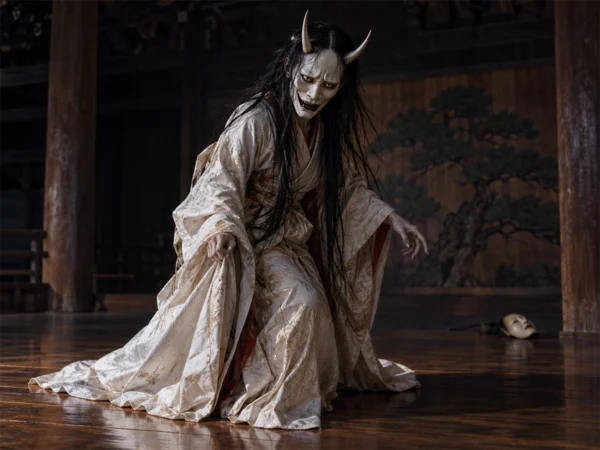
What is the hannya?
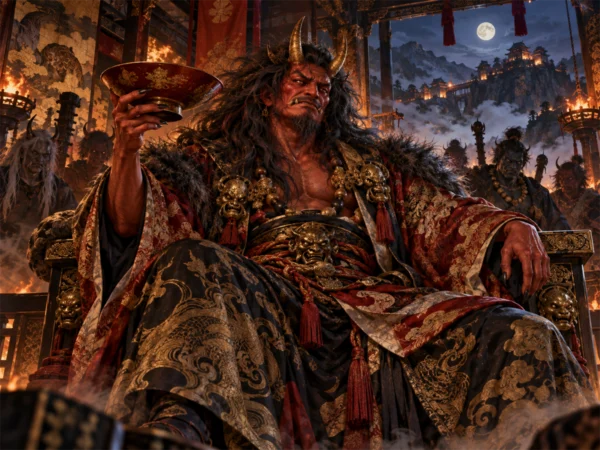
The hannya is a Noh mask representing the face of a woman who has become a demon out of jealousy and resentment. It has two horns on its head, glaring golden eyes and a mouth split wide to the ears, a terrifying expression. Yet deep sorrow is also carved into the brows and eyes, and the mask is said to express a woman’s passion in which anger and grief are mixed.
Where the name comes from
The word hannya is originally a Buddhist term meaning “the wisdom that sees the truth” (prajna). Theories about why the mask came to be called hannya include that it was made by a Muromachi-period mask carver called Hannya-bo, and that it comes from the scene in the Noh play Aoi no Ue in which the living spirit of Lady Rokujo, turned demon, is driven back by a monk chanting the Heart Sutra (Hannya Shingyo).
Stories featuring the hannya
In the Noh play Aoi no Ue, the living spirit of Lady Rokujo, which has possessed Aoi, the wife of Prince Genji, appears wearing a hannya mask. In Dojoji, which portrays Kiyohime, the woman who turns into a serpent wears a mask close to the hannya. Today hannya masks are displayed to ward off evil and used as designs in tattoos and crafts.