What is Ubume?
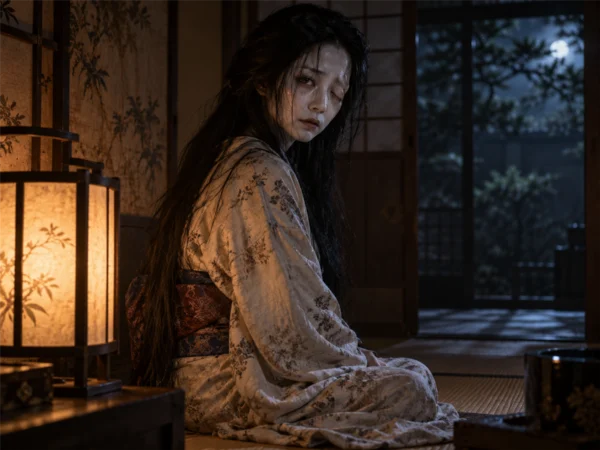
Ubume is a ghost or yokai said to be a woman who died in childbirth, appearing with a baby in her arms. She stands on a road at night or beside a river, wearing a blood-stained underskirt and holding a baby, and asks passers-by, “Please hold this child for me.” The sorrow of childbirth in the past, when mothers and babies often died, is thought to have given rise to this tale.
If you hold the baby…
When someone takes the baby as Ubume asks, it grows heavier and heavier. Those who give in to the weight and let go may lose their lives, but those who keep holding it to the end, for example by chanting the name of the Buddha, are said to be granted superhuman strength. In some tales, the baby in their arms turns out to be a stone, a bundle of leaves or a sheaf of straw.
Ubume in the Konjaku Monogatari
The Heian-period story collection Konjaku Monogatari contains a tale of Taira no Suetake, a retainer of Minamoto no Yorimitsu, who met an Ubume. As a test of courage, Suetake had to cross at night a river where an Ubume was said to appear. In the river he met a woman who tried to make him hold a baby. Suetake took the baby and, ignoring the woman’s cries of “Give it back,” went straight up the bank and home. When he looked, the baby he had been holding had turned into tree leaves.
Why it is written “Kokakuchō”
Ubume is sometimes written with the characters for kokakuchō, a bird yokai from Chinese legend that flew about at night and stole people’s children to raise as its own. Because it was also said to be the transformed spirit of a woman who died in childbirth, it was thought to be the same as Japan’s Ubume, and its characters came to be used for the name. The Edo-period artist Toriyama Sekien also drew Ubume under the name kokakuchō.
The novel The Summer of the Ubume
Ubume has also had a great influence on modern literature. The Summer of the Ubume (1994), the debut novel of the writer Kyōgoku Natsuhiko, is a mystery in which Kyōgokudō, a secondhand bookseller who is also an onmyōji, solves a strange case surrounding a woman who has been pregnant for twenty months. It became popular as a work linking yokai folklore with the mysteries of the human mind, and it was made into a film in 2005. Just as people of the past expressed their anxiety and grief about childbirth through the figure of Ubume, yokai still reflect what lies deep in the human heart in stories today.
Legends of the child-raising ghost
The Ubume tale is also linked to legends of the “child-raising ghost” found in many places. Every night a woman came to a candy shop with a single coin to buy candy. Suspicious, the shopkeeper followed her, and she vanished into a graveyard. When the grave was dug up, a baby born in the grave was found licking candy beside the body of a woman who had died while pregnant. At the Rokudō crossroads in Kyoto, a shop still sells “ghost child-raising candy” named after this legend.
These stories of Ubume and the child-raising ghost carry the deep love of mothers who died leaving their children behind. A similar yokai that appears by the water and makes people hold a baby is the nure-onna of Kyushu and elsewhere. Another famous yokai that grows heavy when held is Konaki-jijii.