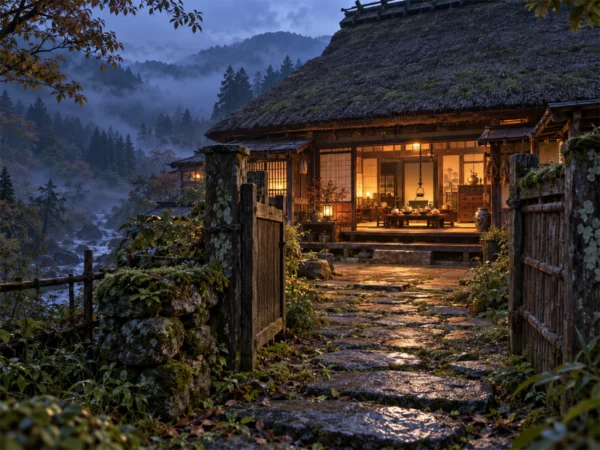
What is Mayoiga?
Mayoiga (“the house where one gets lost”) is a mysterious mansion said to be found by chance by people who lose their way in the mountains. It is a story from the Tono area of Iwate Prefecture, introduced by the folklorist Yanagita Kunio in The Legends of Tono (1910), which he wrote down from the tales of Sasaki Kizen, a native of Tono.
No one is ever inside the Mayoiga, yet it feels as if people were living there only moments before. It is said that those who find it will be blessed with good fortune if they take one thing from it home with them.
The red bowl that floated down the river
Tale 63 of The Legends of Tono is about the wife of a poor household in the village of Oguni. While gathering butterbur in the mountains, she wandered deep into a valley and found a fine mansion with a black gate. The garden was full of red and white flowers, many chickens were wandering about, and there were cattle sheds and stables at the back. When she went inside, the parlor was laid out with many splendid red and black trays and bowls, and an iron kettle was boiling on the brazier, yet there was no one to be seen. Afraid it might be the home of a mountain man, she took nothing and ran home.
One day, while washing things in the stream in front of her house, she saw a single red bowl floating down from upstream. It was so beautiful that she picked it up. Thinking she would be scolded if she used it for anything dirty, she used it to measure rice from the rice chest. After that, no matter how much rice she measured out, the chest never ran empty, and the household eventually became the richest in the village. The tale concludes that because she was free of greed and took nothing, the Mayoiga sent the bowl to her.
The man who found nothing
In Tale 64, a man from the village of Kanazawa got lost in the mountains on his way to the family he was marrying into and found a similar mansion. When he told his village, the people said, “That is a Mayoiga. Let’s go and bring back its trays and bowls and become rich,” and many of them went into the mountains with him as their guide. But however hard they searched, the mansion was never found again. The Mayoiga does not appear to those who go looking for it out of greed.
Legends of hidden villages
Stories of rich villages or houses hidden from human eyes deep in the mountains or under the water are told all over Japan as “kakurezato” (hidden villages). The Mayoiga tales reflect how people once saw the mountains as a strange other world that both gave blessings and led people astray. They share something with tales of kamikakushi, in which people vanish in the mountains.
Parallels with China’s “Peach Blossom Land”
The Mayoiga tales closely resemble The Peach Blossom Spring, written in the 4th to 5th century by the Chinese poet Tao Yuanming. A fisherman following a river upstream found, beyond a grove of blossoming peach trees, a village living peacefully cut off from the outside world, and was made welcome there. But after he left, he could never find the way back, however hard he tried. The expression “peach blossom land” born from this story is still used as a byword for an ideal world. Tales of mysterious places that can only be reached by chance and cannot be found by searching have been told across borders.
Mayoiga in modern works
Mayoiga appears in modern novels, anime and films as a motif of a mysterious house deep in the mountains. Tono is still known as a “home of folktales,” visited by people tracing legends of kappa, zashiki-warashi and Oshirasama.