What is Oshirasama?
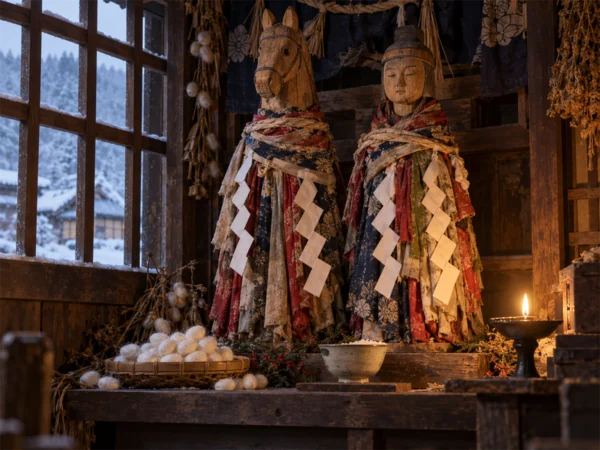
Oshirasama is a household deity worshipped in old families of the Tohoku region, such as in Iwate and Aomori prefectures. It is a pair of figures made from sticks of mulberry wood about 30 cm long, with the face of a horse and the face of a girl (or a man) carved or painted on the tips, dressed in many layers of cloth called osendaku.
Besides protecting the house, it is worshipped as a god of silkworm raising, farming, eyes and children. On New Year’s and on spring and autumn festival days, an itako (shamaness) has traditionally held the Oshirasama in both hands and shaken them while chanting, in a rite called “oshira-asobase” (letting Oshira play).
The Oshirasama legend in The Legends of Tono
The Legends of Tono (1910), written down by Yanagita Kunio from the stories of Sasaki Kizen, records the following tale of Oshirasama’s origin.
Long ago, a poor farmer had a beautiful daughter who grew close to the family’s horse, and at last the two became husband and wife. The angry father hung the horse from a mulberry tree and killed it. As the grieving daughter clung to the horse’s neck and wept, the father cut off its head with an axe. The daughter then rose to heaven riding on the head, and became Oshirasama. In another version, the daughter appeared in her parents’ dream after rising to heaven and told them silkworms would appear in their mortar, which is why Oshirasama is the god of silkworms.
Sayings about Oshirasama
Oshirasama also has the side of a god who brings a curse if worshipped wrongly, with sayings such as “eating the meat of four-legged animals brings punishment” and “treat Oshirasama carelessly and your mouth will twist.” The Oshira-do hall at the Densho-en folk museum in Tono, Iwate Prefecture, houses about 1,000 Oshirasama figures, an overwhelming sight. Together with the zashiki-warashi and kappa of Tono, it conveys the rich folk beliefs of northern Japan.