Kappa

河童

Yokai

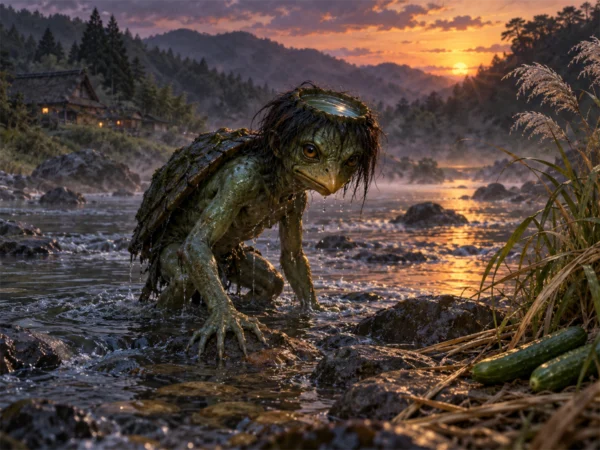
A water yokai said to live in rivers and ponds, with a dish of water on top of its head. Alongside frightening tales, it is known for friendlier ones, such as its love of sumo wrestling and cucumbers.

Also known asKawataro, Gataro, Medochi, Hyosube, Suiko, River child
Era / first recordedEdo period (widespread)
OriginJapan
Related people
Stats
Rarity
Danger
Reality
Fame

Originally written in Japanese. 日本語版を読む (the Japanese page also has rankings and comments).

A water yokai found all over Japan

The kappa is a yokai said to live in rivers, swamps and ponds. It is about the size of a child, with a dish of water on top of its head, a shell on its back and webbed hands and feet. It goes by many regional names, including kawataro, gataro, medochi and hyosube.

Frightening tales and friendly ones

Some stories say the kappa drags people and horses into the water, or pulls out a mysterious organ called the shirikodama. Many others are far friendlier: the kappa loves sumo wrestling, loses its strength if the water in its head-dish spills, adores cucumbers, and in some tales teaches a recipe for medicine to thank a person who helped it.

The kappa of Tono

Yanagita Kunio’s The Legends of Tono (1910) records several kappa stories from the Tono area of Iwate Prefecture. Tono still has a pool where kappa are said to have appeared, now a popular tourist spot. Kappa stories are also thought to have served as warnings, teaching children about the dangers of the water.

Kappa: Legend & Sighting Locations

Please note Trespassing on private property or restricted areas is prohibited by law. Please be considerate of local residents.

Positions on the map are a rough guide to the area where a legend or sighting is set. Most pins are placed at representative points of a municipality or prefecture (outside Japan, a city position rounded to about 10 km, or the country), not at the exact place.
Municipality points: Geolonia address data (CC BY 4.0), based on the Address Base Registry (Digital Agency of Japan) / Country points: Natural Earth

Sources & References

  1. 遠野物語 (柳田國男, 1910)

Please note The contents of this site introduce legends, eyewitness accounts and theories; they do not guarantee that anything described is true. The stats are our own rough guide. Trespassing on private property or restricted areas is prohibited by law. Please be considerate of local residents.

Related Entries