What is a baku?
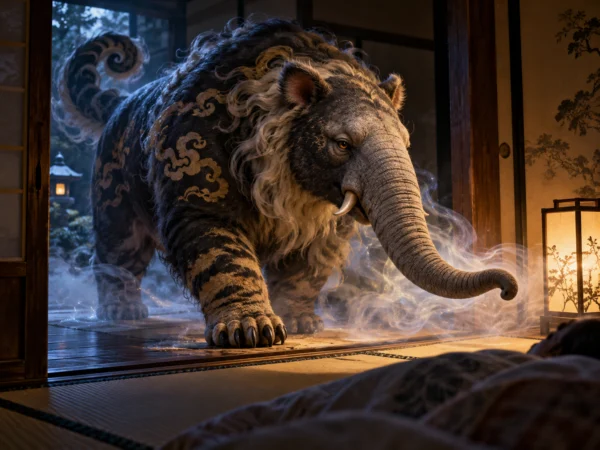
The baku is a sacred beast said to eat the bad dreams people have. It is depicted as a composite of several animals, with an elephant-like trunk, rhinoceros-like eyes, an ox-like tail and tiger-like legs. Originally a legendary creature of China, it was believed that sleeping on its pelt or placing a screen painted with its image would keep away illness and evil. The Tang poet Bai Juyi left a piece of writing about a screen painted with a baku.
The baku that eats nightmares
In Japan, the baku spread as a creature that “eats bad dreams.” It is said that if you have a frightening dream and chant “I give this dream to the baku,” you will never have the same dream again. From the Muromachi to the Edo period, to make the first dream of the New Year a good one, there was also a custom of writing the character for “baku” on the picture of the Seven Lucky Gods’ treasure ship placed under one’s pillow. The baku’s image is also used in temple and shrine carvings and pillow decorations.
Link with the tapir
The tapir, an animal of Southeast Asia and Central and South America, has a long nose and looks much like the legendary baku, so in Japanese it was named “baku.” The legendary baku came first, and its name was later given to the newly found animal, just as the giraffe was named after the legendary kirin.
Mysteries of dreams
Other mysterious beings linked with dreams include the Sandman of Europe, who sprinkles sleep sand on children, and Ole Lukoje, who brings dreams. As in the urban legend of the monkey dream, which many people claim to have dreamed, dreams still give rise to many mysteries.