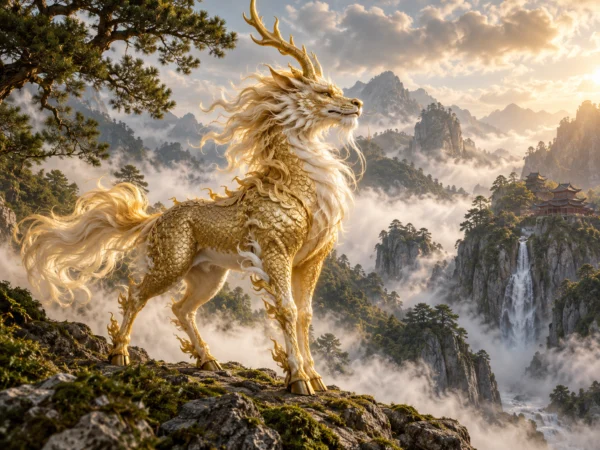
What is the kirin?
The kirin (qilin in Chinese) is a sacred beast of Chinese legend. It is said to have the body of a deer, the tail of an ox and the hooves of a horse, with a single horn on its head, and is sometimes depicted covered in scales. “Ki” is said to be the male and “rin” the female. It is extremely gentle, and was said to walk so as not to step on living insects or break blades of grass.
A sacred beast that appears under a wise ruler
Together with the dragon, the phoenix and the sacred tortoise, the kirin was called one of the “Four Benevolent Animals,” auspicious beings that appear when a virtuous ruler governs and the world is at peace. In the time of Confucius, a kirin was reportedly captured in a hunt, and Confucius lamented that “a kirin appeared in a chaotic age and was captured,” and laid down his brush on the history Spring and Autumn Annals, the story known as “the capture of the kirin.” From this, the phrase came to mean the end of something or one’s last writing.
Why the giraffe is called “kirin” in Japanese
In the early 15th century, in the reign of the Ming emperor Yongle, the great fleet of Zheng He brought back a long-necked animal from the direction of Africa. Because its name in Somali and other languages sounded like “qilin” and it looked so unusual, it was presented to the emperor as the legendary qilin, it is said. The Japanese word “kirin” for the giraffe comes from this legendary beast.
The kirin in Japan
In Japan, too, the kirin has been depicted as an auspicious beast in temple and shrine carvings and in crafts. Its name lives on in the kirin on a famous beer label and in the word kirinji (“kirin child”) for a gifted young person. Other well-known Chinese sacred beasts include the hakutaku and Seiryu of the Four Symbols.