What is a yamauba?
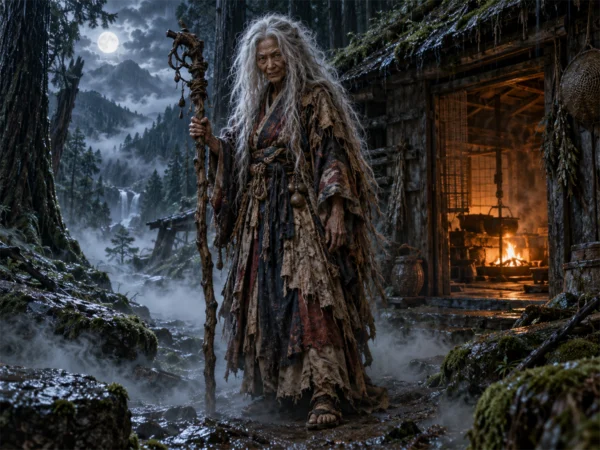
The yamauba (or yamanba) is an old woman yokai said to live deep in the mountains. She is often described with wild, long white hair and a mouth split to her ears, and has been feared as a hag who eats people who stray into the mountains. Toriyama Sekien also drew her in his Edo-period yokai books.
The yamauba of folktales
In the folktale “The Three Charms” (Sanmai no Ofuda), a young temple acolyte strays into a yamauba’s house and escapes using three charms given to him by his master. In “The Ox Driver and the Yamauba,” an ox driver carrying fish over the mountains is chased by a yamauba. Such tales may also have warned children not to go into the mountains alone. Frightening old women of the mountains and forests appear around the world too, such as the British hag.
The yamauba as a mountain goddess
The yamauba has also been told of as a mountain goddess who brings the mountains’ bounty. One legend says the mother of Kintaro (Sakata no Kintoki) of Mount Ashigara was a yamauba, and the Noh play Yamamba portrays her as a mysterious being who wanders the mountains speaking of the laws of nature. She is a yokai with two faces: a terrifying hag and a goddess of the mountains.