What is Ōnyūdō?
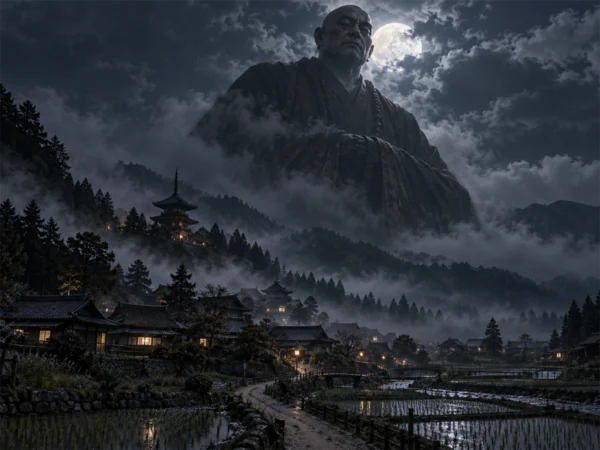
Ōnyūdō (“great priest”) is a yokai that appears as a towering figure with a shaven head. The word “nyūdō” originally meant a person who had taken Buddhist vows and shaved his head, and came to be used for shaven-headed giants and monsters as well. Ōnyūdō suddenly appears on night roads, mountain passes and riverbanks to frighten passers-by. Its height varies from story to story, from a few meters to far taller than a house or a tree.
Really a tanuki or a fox
Stories of Ōnyūdō are told all over Japan, and in many of them its true identity is an animal that tricks people, such as a tanuki, a fox, an otter or a weasel. A common tale tells of someone who fled from an Ōnyūdō and later found signs that a tanuki had been in disguise. In other stories, the giant reveals its true form and runs off when someone sweeps at its feet with a stick or blows tobacco smoke at it. Mistaking the shadow of a tree or a large rock on a dark road for a giant figure may also have given rise to these tales.
Relationship to Mikoshi-nyūdō
A very similar yokai is the mikoshi-nyūdō. It first appears as a small monk, then grows taller and taller the more you look up at it; if you keep looking up, you fall backward and die. Saying “I’ve seen over you!” is said to make it vanish. The Miage-nyūdō of Sado Island in Niigata Prefecture belongs to the same family. The Edo-period artist Toriyama Sekien drew a “Mikoshi” stretching its neck to peer down from a tree in his 1776 Gazu Hyakki Yagyō. Ōnyūdō and mikoshi-nyūdō are often treated as the same yokai, and Edo-period picture books sometimes showed a long-necked ōnyūdō as the boss of all yokai.
The Ōnyūdō of the festival
Ōnyūdō also appears in festivals. At the Yokkaichi Festival in Yokkaichi City, Mie Prefecture, a float carrying a huge mechanical puppet called “Ōnyūdō,” whose neck stretches and shrinks, parades through the streets. It is an example of a frightening yokai becoming the beloved star of a town festival.
Where the word “nyūdō-gumo” comes from
The towering cumulonimbus clouds that billow up into the summer sky are called “nyūdō-gumo” (great-priest clouds) in Japanese. The name is said to come from seeing them as an ōnyūdō, a shaven-headed giant, rising up huge into the sky. To people of the past, a cloud looming so high that you had to crane your neck to see it must have looked exactly like an ōnyūdō. These clouds can bring violent thunderstorms, so they were also feared. It is an example of a yokai’s name still living on as an everyday word for nature.
If you meet a mikoshi-nyūdō
If you meet a mikoshi-nyūdō that grows taller the more you look up, you must never keep looking up at it. In some regions, calling out “Mikoshi-nyūdō, I’ve seen through you!” or “I’ve seen over you!” makes it vanish, while looking up from bottom to top only makes it grow larger. Another tradition says you should not look from its feet to its head, but look down from its head to its feet. It reflects an idea common in folktales: a yokai whose true nature is seen through loses its power.
Giants of the sea and land
Giant shaven-headed yokai of the sea are called umibōzu and are said to sink ships and threaten sailors. A famous giant of the mountains is Daidarabotchi, said to have shaped the land. In tales of yokai that frighten people with their great size, the darkness and loneliness of night roads may have taken the form of a giant shadow.