What is Shiranui?
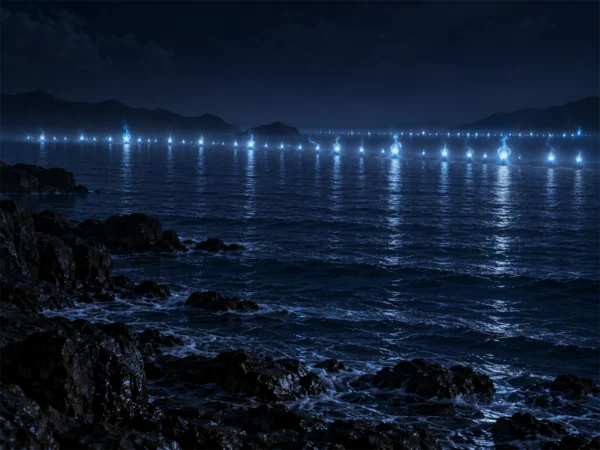
Shiranui (“unknown fires”) is a mysterious light said to appear on the Yatsushiro Sea and Ariake Sea in Kyushu. Every year, on a calm, moonless night around the first day of the eighth month of the old lunar calendar (Hassaku), one or two fires called “oyabi” (parent fires) appear offshore. They then split to the left and right and multiply, until hundreds or even thousands of fires stretch in a line for several kilometers. It was said that if you tried to approach, the fires would retreat, and you could never reach them. The Yatsushiro Sea is also called the Shiranui Sea.
Emperor Keikō and the “unknown fire”
The origin of the name is recorded in the Nihon Shoki and the regional records of Hizen and Higo compiled in the Nara period. After Emperor Keikō subdued the Kumaso people of Kyushu, he was traveling by boat when night fell and, in the darkness, he could no longer tell where the shore was. Then a fire appeared ahead. He had the boat steered toward it and reached the shore safely. When he asked who had lit the fire, not even the local people knew, so it came to be called “shiranu hi,” the fire no one knows. The name “Hi no Kuni” (Land of Fire) for this region is also said to come from these fires.
A famous night-time spectacle
From the Edo period to the Meiji period, Shiranui was a well-known attraction on the night of the first day of the eighth lunar month, and many people gathered on hills by the sea to watch. Some said the fires were lit by the dragon god, and on that night people would put their hands together in prayer toward the sea.
The true nature of Shiranui: a mirage
Scientific study of Shiranui began around the Taishō period, and today it is thought to be a kind of mirage. Around Hassaku, the low spring tides in the middle of the night expose wide tidal flats on the Yatsushiro Sea. The flats cool down, creating a large temperature difference between the air above them and the air above the warmer sea. When light passes through layers of air at different temperatures it bends, so the lights of distant fishing boats appear stretched sideways or split into many. They are said to be easiest to see around 3 a.m., when the tide is at its lowest.
Things named after Shiranui
The name Shiranui is used for many things. In sumo, there are two styles of the yokozuna’s ring-entering ceremony, “Unryū” and “Shiranui,” and the Shiranui style is said to be named after Shiranui Kōemon, an Edo-period yokozuna from Kumamoto. The citrus fruit known as “Dekopon,” grown in Kumamoto Prefecture and elsewhere, is the name given to fruit of the “Shiranui” variety that meets certain standards. The name of the mysterious sea fires handed down since ancient times still lives on as a source of pride for Kumamoto.
A vanishing spectacle
Because of land reclamation of the tidal flats, brighter coastlines at night and changes in fishing methods, Shiranui has become very hard to see today. Even so, a high school science club in Kumamoto Prefecture continues to study it. In 2023 the students succeeded in reproducing a Shiranui-like mirage with a model, and in 2024, with the cooperation of a fishing cooperative, they reportedly succeeded in filming lights on fishing boats spreading out sideways during observations at sea.
Other mysterious lights and phantoms of the sea include the umibōzu and funayūrei, which are also told of in the seas of Kyushu. Kitsunebi, fox fires, are another kind of mysterious fire told of across Japan.