What is Sunakake-babā?
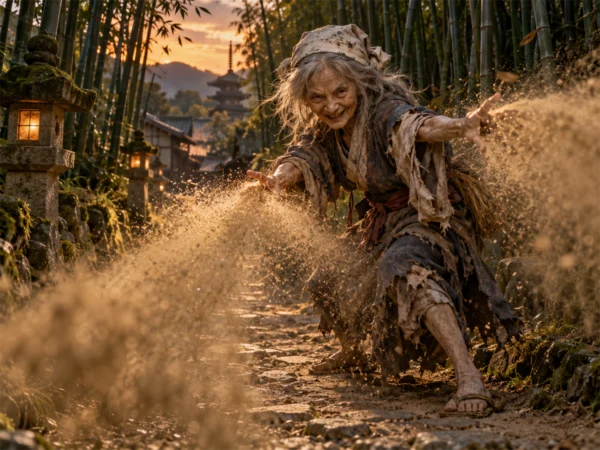
Sunakake-babā (“sand-throwing old woman”) is a yokai that startles people passing through deserted woods or near shrines by sprinkling sand on them from nowhere. It is told of in Nara, Hyogo and Shiga Prefectures. The folklorist Yanagita Kunio introduced it as a tale from Nara Prefecture in his “Yōkai Meii,” a collection of yokai names from across Japan included in his book Yōkai Dangi.
Being showered with sand usually means only a fright, not real harm. It is a mischievous yokai that seems to enjoy surprising people for its own sake.
No one has ever seen her
In fact, in the original folklore, no one has ever seen Sunakake-babā. The original story is simply the sound and feel of sand falling, with no one there when you look up. She does not appear in Edo-period picture scrolls either, so she was a “phenomenon yokai” with no form. In one tale from Nishinomiya in Hyogo Prefecture, the sound of sand being thrown came from the top of a pine tree, yet no sand actually fell.
Sunakake-babā around Japan
In Amagasaki, Hyogo Prefecture, people said you would be sprinkled with sand if you passed through the torii gate of an Inari shrine at night. In Nishinomiya and Amagasaki, the sand-throwing was thought to be the work of tanuki. In Kusatsu, Shiga Prefecture, there is a tale of an old woman living in a bamboo grove who threw sand, and in Rittō it is blamed on an animal called “tenkoro,” said to be a cross between a tanuki and a weasel.
Similar stories of tanuki, weasels or monks throwing sand are found throughout Japan, in Fukuoka, Aomori, Niigata, Chiba and Tokushima Prefectures. One theory suggests birds in the trees were shaking sand from their feathers.
Sunakake-babā in GeGeGe no Kitaro
It was the manga artist Mizuki Shigeru who gave the formless Sunakake-babā the appearance of an old woman in a kimono. In his manga GeGeGe no Kitaro, she is one of Kitaro’s reliable allies, fighting alongside Konaki-jijii and others. This image became so firmly established that today almost everyone pictures Sunakake-babā as an old woman with her eyes closed. A bronze statue of her stands on Mizuki Shigeru Road in Sakaiminato, Tottori Prefecture.
Why throw sand near shrines?
It may not be a coincidence that so many Sunakake-babā stories take place in shrine woods, near torii gates, or in lonely groves. For villagers of the past, the woods of a shrine belonged to the gods and were a special place one should not enter carelessly at night. In a dark wood, the sound of something falling from the branches or sand blown up by the wind may have felt like the work of a yokai. The tales probably also served to warn children not to go near shrines at night. The Amagasaki story of being sprinkled with sand when passing through a shrine’s torii reflects this feeling.
Why “old woman”?
It is not clear why a yokai no one had seen came to be called an “old woman” (baba). One theory links it to an old dialect word “baba” meaning something dirty. Like Konaki-jijii, who grows heavy when held, she is an example of a small local legend turned into a nationally popular yokai by manga. Other yokai known only by sound include Betobeto-san, whose footsteps follow you on a night road, and Azukiarai, who makes the sound of washing beans.