What is a noppera-bo?
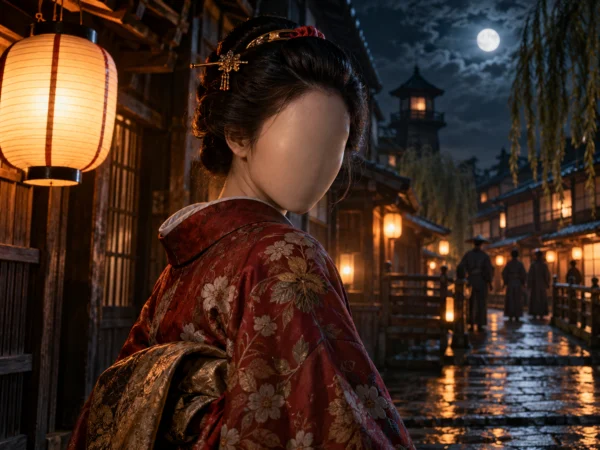
The noppera-bo is a yokai with a face as smooth as an egg, with no eyes, nose or mouth. It appears in the form of an ordinary person and startles people when it turns its face toward them. It almost never harms anyone; startling people seems to be its whole purpose. Its true identity is often said to be a shapeshifting tanuki, mujina (badger) or fox.
Lafcadio Hearn’s “Mujina”
The most famous noppera-bo story is “Mujina,” included in Kwaidan, published in 1904 by Lafcadio Hearn (Koizumi Yakumo). On the Kii-no-kuni slope in Akasaka, Edo, a merchant speaks to a young woman who is crying; when she turns around, her face has no eyes, nose or mouth. The merchant flees and rushes to a soba noodle stall to tell what happened. The soba seller says, “Was it like this?” and strokes his face, and his face too becomes as smooth as an egg.
The “startle twice” pattern
The story pattern of escaping one supernatural encounter, feeling relieved, and then meeting the same horror again is called “saido no kai” (the second encounter), and it is the classic form of noppera-bo tales. Because Hearn wrote in English, the noppera-bo became a Japanese yokai known abroad by the name “Noppera-bo.”
Yokai with similar names
Edo-period scrolls also depict a yokai called the nuppeppo, a lump of flesh with folds like a face, which is sometimes considered the same as the noppera-bo. Another famous yokai that tricks and startles people is the shapeshifting tanuki.