What is Tōfu-kozō?
Tōfu-kozō (“tofu boy”) is a yokai in the form of a child wearing a large straw hat and holding a block of tofu on a tray with both hands. In the late Edo period, from around the An’ei era (1772-1781), he began appearing in kusazōshi, illustrated popular books, and became a favorite of the people of Edo. An early example is the 1779 kibyōshi picture book Bakemono Shiuchi Hyōbanki.
A yokai who does no harm
Tōfu-kozō is depicted following people on rainy nights or carrying tofu and sake. He almost never does anything bad to people; he is timid, good-natured and a little clumsy. In stories he is often teased or bullied by other yokai, playing a role that is impossible to dislike. Drawn not to frighten but to make readers laugh, he can be called the original “character yokai.”
The maple leaf on the tofu
The tofu Tōfu-kozō carries often bears the pattern of a maple leaf. This is “momiji-dōfu” (maple tofu), a kind of tofu actually sold in the late Edo period, said to have been a seasonal tofu sold near famous autumn-leaf viewing spots. Tofu was an everyday food for ordinary people at the time, and Tōfu-kozō was a yokai born from the ordinary life of the city of Edo.
Relationship to Hitotsume-kozō
Some pictures of Tōfu-kozō show an ordinary child’s face, while others give him a single eye in the middle of his face. Because many pictures also show Hitotsume-kozō carrying tofu, one theory holds that Tōfu-kozō is another name for Hitotsume-kozō, while another says he was born as a separate yokai. The question has not been settled.
The “bakemono” boom of Edo
In the late Edo period, when Tōfu-kozō was born, one illustrated book after another was published that made yokai a source of laughter. The yokai in these books were drawn not so much as frightening beings but as rather comical “bakemono” (monsters) who failed and struggled with their work just like humans. Even the popular writer Jippensha Ikku wrote works with yokai as the main characters. The people of Edo did not only fear yokai; they enjoyed them as familiar characters. Tōfu-kozō can be called a representative of that Edo yokai culture.
From toy prints to modern works
From the end of the Edo period into the Meiji era, Tōfu-kozō also appeared on children’s “toy prints” such as kites, sugoroku board games and karuta cards, and was widely loved. Shōwa-era yokai encyclopedias added the idea that eating his tofu makes mold grow on your body, but this does not appear in Edo-period sources and was added later.
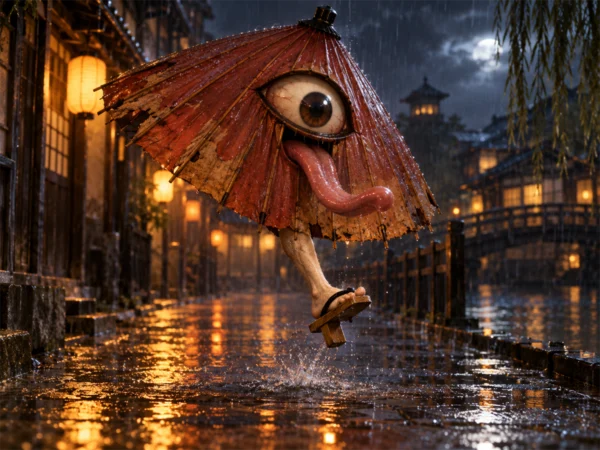
Since the Heisei era, books introducing Edo yokai picture books have brought Tōfu-kozō back into the spotlight, and he became the hero of the novel Tōfu Kozō Sugoroku Dōchū Furidashi (2003) by the writer Kyōgoku Natsuhiko. Other playful Edo yokai include Karakasa-kozō and Chōchin-obake.