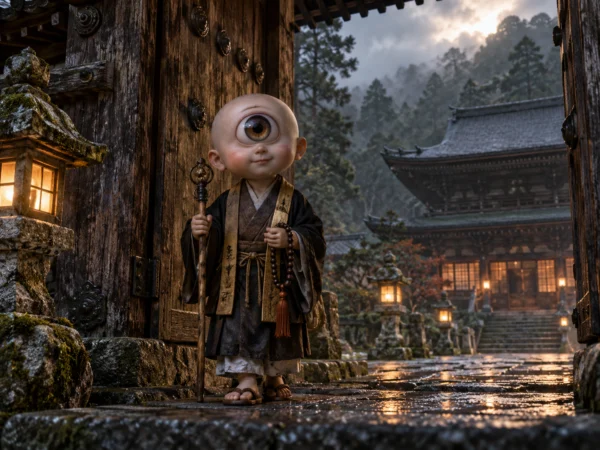
What is a hitotsume-kozo?
The hitotsume-kozo is a yokai in the form of a shaven-headed child with a single large eye in the middle of its face. It suddenly appears on night roads or in old mansions and startles people by sticking out its long tongue, but does no great harm. It was drawn often in Edo-period illustrated books and ukiyo-e, and has been loved as a cute “little monk” yokai alongside the tofu-carrying tofu-kozo.
The one-eyed boy who comes on Koto-yoka
In the Kanto region and elsewhere, it was believed that on “Koto-yoka,” February 8 and December 8, a hitotsume-kozo or other one-eyed yokai went from house to house doing harm. On these days there was a custom of attaching a bamboo basket with many holes (a “megago,” literally “eye basket”) to the end of a pole and raising it high at the eaves. One-eyed yokai were thought to be startled and flee at the sight of a basket with so many “eyes.” In some regions, the hitotsume-kozo was said to write down each household’s doings in a ledger on December 8 and leave it with the roadside guardian deity until February 8, and the god of pestilence would use the ledger to decide which houses to strike.
Yanagita Kunio’s “Hitotsume-kozo”
In his book Hitotsume-kozo and Other Essays (1934), the folklorist Yanagita Kunio argued that one-eyed yokai might be fallen gods, a remnant of an ancient custom of putting out one eye of a person chosen as a sacrifice to the gods. The theory is now considered an unverifiable hypothesis, but it is often cited when discussing the origins of one-eyed yokai.
One-eyed monsters around the world
One-eyed monsters are told of around the world, the best known being the Cyclopes, giants of Greek mythology. Compared with them, Japan’s hitotsume-kozo is distinctive for being small and charming.