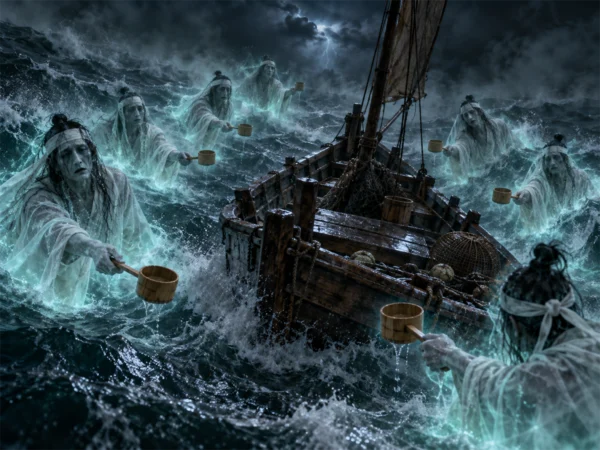
What is Funayūrei?
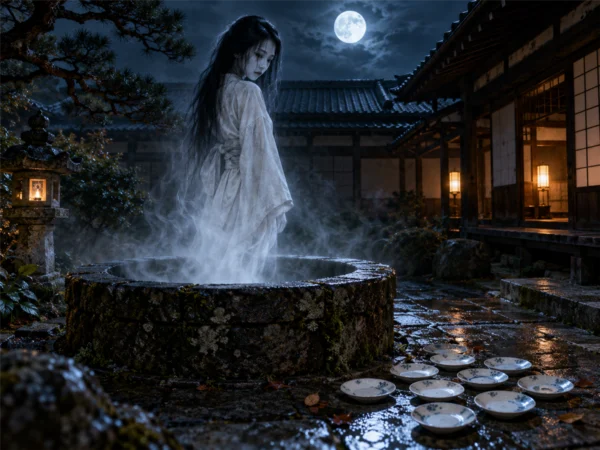
Funayūrei (“ship ghosts”) are the spirits of people who died at sea and approach boats. They appear around boats on the sea at night and call out, “Lend us a ladle.” If the ladle is handed over, the ghosts use it to scoop seawater into the boat until it sinks. Tales of them are found along almost every coast in Japan, and in inland regions they are said to appear on rivers, lakes and ponds.
The bottomless ladle
The way to escape that is told in many places is to hand over a ladle with its bottom knocked out. With a bottomless ladle, no matter how much water the ghosts scoop, they cannot fill the boat. For this reason, fishermen and sailors of the past are said to have carried ladles with the bottoms removed in case they met funayūrei. In other tales, throwing rice balls into the sea as an offering to the ghosts saves the crew.
When funayūrei appear
Funayūrei were said to appear most often on stormy nights or nights of thick fog. People were also warned that if they went fishing during Obon, especially on the 16th day of the Obon month, the spirits of the dead would come up to the side of the boat. There are also tales of a sailing ship full of ghosts appearing on moonlit Obon nights. Their link to Obon is thought to overlap with the image of the spirit boats on which the souls of the dead are sent out to sea.
Names around Japan
Funayūrei are called by different names in different places: “Ayakashi” in Yamaguchi and Saga Prefectures, “Inada kase” (“lend me an inada,” a ship’s ladle) in Fukushima Prefecture, “Murasa” in the Oki Islands of Shimane Prefecture, and “Mayoi-bune” (“lost ship”) in Fukuoka Prefecture. The Edo-period picture book Ehon Hyaku Monogatari depicted the funayūrei of the seas off Kyushu as the spirits of Heike warriors who perished at Dan-no-ura. Ghosts of the dead appearing at sea are also depicted in Toriyama Sekien‘s yokai picture book Konjaku Gazu Zoku Hyakki (1779).
Funayūrei and umibōzu
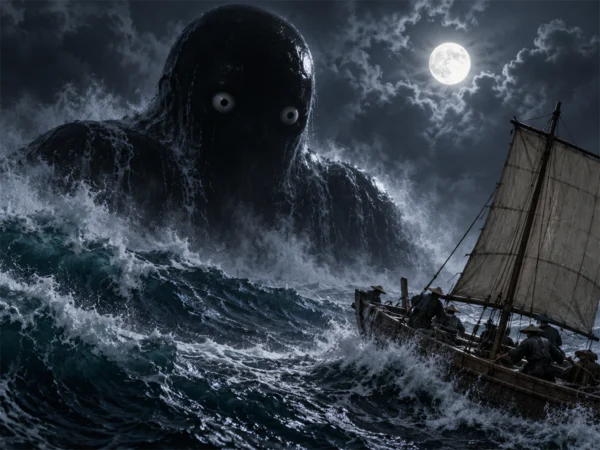
Funayūrei are often told of together with the umibōzu, a giant shaven-headed yokai that appears at sea. Both are said to attack boats on stormy or foggy nights, and in some regions the umibōzu also asks for a ladle. The big difference is that funayūrei are thought to be the spirits of people who died at sea, that is, beings that were once human, while umibōzu are usually described as sea monsters of unknown nature. Sailors passed down the dangers of the sea in the form of these various phenomena and prayed to the sea gods for a safe return.
What are funayūrei?
People of the past believed that those who died at sea and were never properly mourned became funayūrei. In an age of frequent shipwrecks, the funayūrei tales were probably also a warning not to take boats out recklessly in storms and fog.
Another theory suggests that a strange phenomenon in which a boat suddenly stops moving forward gave rise to the tales. Near river mouths, lighter water with less salt can form a thin layer near the surface of the sea. When this happens, the power of a boat’s oars or propeller can be used up in making waves along the boundary between the layers, so the boat barely moves. This is known as “dead water,” and the polar explorer Fridtjof Nansen recorded the same experience on top of meltwater from ice.
In some tales of the giant sea yokai umibōzu, sailors are also asked to lend a ladle; funayūrei and umibōzu were both sea phenomena that sailors feared. The Shiranui are a famous kind of mysterious fire that appears at sea.