Was the okapi a phantom animal?
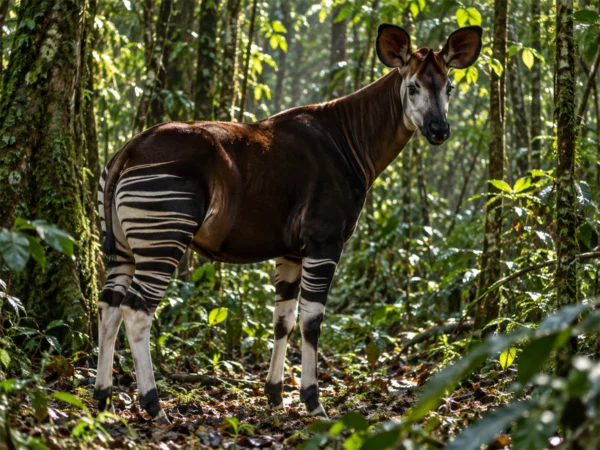
At the end of the 19th century, Henry Morton Stanley, exploring central Africa, heard from people of the Congo rainforest about a “forest animal resembling a donkey” and recorded it. But no European had actually seen one, and it was considered a phantom animal, sometimes called the “African unicorn.”
How it was discovered and confirmed
Intrigued by Stanley’s account, the British explorer Harry Johnston obtained pieces of striped skin from local people and sent them to Britain in 1901. At first it was thought to be a new species related to the zebra, but when a complete skin and skull were obtained, it turned out to be a relative of the giraffe. Its scientific name, Okapia johnstoni, preserves Johnston’s name.
What we know today
The okapi is a member of the giraffe family that lives only in the tropical rainforest of the Democratic Republic of the Congo. It has zebra-like stripes on its legs and strips leaves with its long tongue. Together with the giant panda and the pygmy hippopotamus, it is called one of the “world’s three great rare animals.” It is listed as endangered because of deforestation of its habitat and other threats.