Is the frilled shark the real sea serpent?
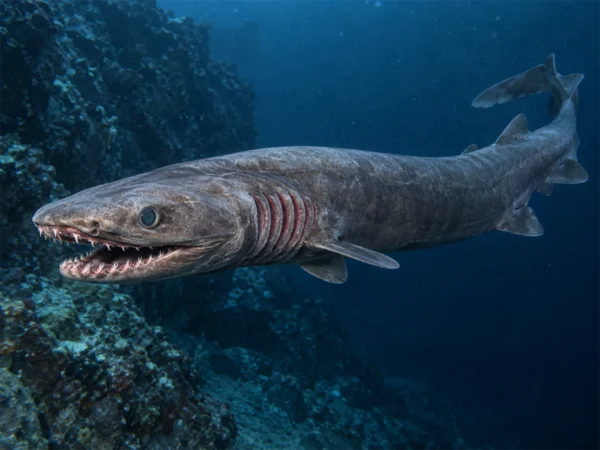
The frilled shark is a deep-sea shark with a long, slender, eel-like body and frilly, collar-like gill slits. It is said to retain features of ancient sharks from more than 300 million years ago, and because of its eerie appearance, some suggest it is the true identity of the sea serpents seen by sailors.
How it was discovered and confirmed
Because it lives in the deep sea, the frilled shark was rarely seen by people. In 1884, the American zoologist Samuel Garman described it as a new species from specimens collected in Sagami Bay, Kanagawa Prefecture. The title of his paper was “An Extraordinary Shark.” Sagami Bay and Suruga Bay are still known as places where frilled sharks are often found. In 2007, a living one was filmed swimming in Numazu, Shizuoka Prefecture, making worldwide news.
What we know today
The frilled shark lives in the deep sea at about 500–1,000 meters and is thought to swallow squid and fish whole with its roughly 300 sharp teeth. One theory says its pregnancy can last three and a half years, among the longest of any vertebrate. Because it retains many primitive features, it is called a “living fossil.”