Oni

鬼

Yokai

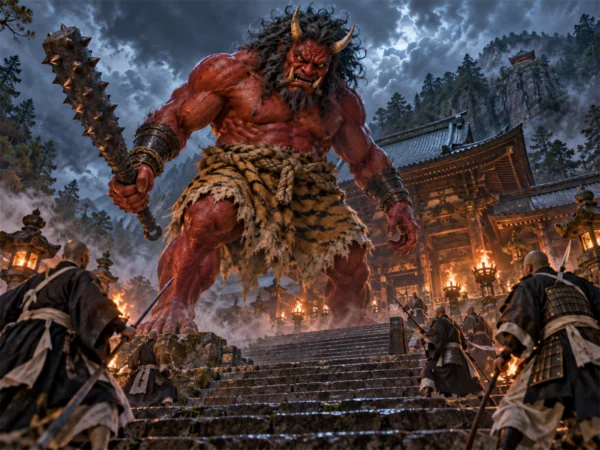
The quintessential Japanese yokai, with horns on its head and a tiger-skin loincloth. It is familiar from the Setsubun bean-throwing festival and the folktale Momotaro. Its appearance is said to come from the "ushitora" direction of the demon gate.

Also known asAka-oni (red oni), Ao-oni (blue oni), Kishin, Japanese ogre, Japanese demon
Era / first recordedAncient times onward
OriginJapan
Related people
Stats
Rarity
Danger
Reality
Fame

Originally written in Japanese. 日本語版を読む (the Japanese page also has rankings and comments).

What is an oni?

The oni is one of Japan’s most iconic yokai. It is usually pictured as a huge man with red or blue skin, horns on its head, fangs in its mouth, an iron club in its hand and a loincloth of tiger skin. Since ancient times it has appeared in countless stories as a terrifying being that attacks people, carries them off and eats them.

The origin of the name and the look

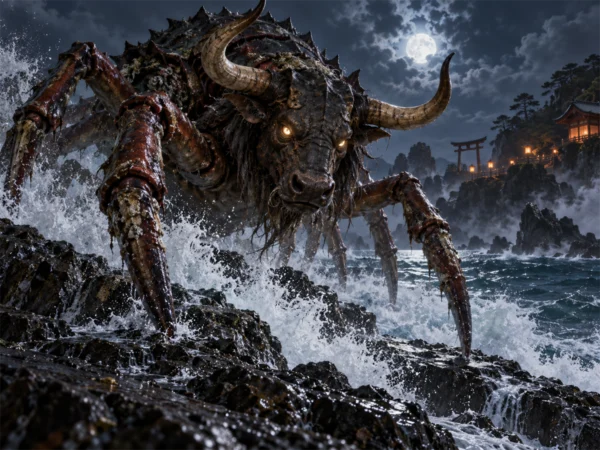
One theory holds that the word oni comes from onu (隠), meaning something hidden or unseen. It may originally have referred broadly to frightening things with no clear form, such as invisible calamities or the spirits of the dead. Its horns and tiger skin are said to come from the northeast direction known as the kimon (“demon gate”), through which oni were believed to come and go. In the Chinese zodiac this direction is “ushitora” (ox-tiger), so the oni was given the horns of an ox and the skin of a tiger.

Oni in stories and at Setsubun

There are countless oni stories, from the folktales Momotaro and Issun-boshi to the legend of Shuten-doji of Mount Oe. At Setsubun, people throw beans while shouting “Oni wa soto, fuku wa uchi!” (“Demons out, good luck in!”), driving away the evil that arrives with the change of seasons in the shape of an oni. Yet some oni are protectors that ward off misfortune, like the onigawara roof tiles or the Namahage of Akita, and the children’s story The Red Oni Who Cried portrays a gentle oni.
Oni: Legend & Sighting Locations

Please note Trespassing on private property or restricted areas is prohibited by law. Please be considerate of local residents.

Positions on the map are a rough guide to the area where a legend or sighting is set. Most pins are placed at representative points of a municipality or prefecture (outside Japan, a city position rounded to about 10 km, or the country), not at the exact place.
Municipality points: Geolonia address data (CC BY 4.0), based on the Address Base Registry (Digital Agency of Japan) / Country points: Natural Earth

Please note The contents of this site introduce legends, eyewitness accounts and theories; they do not guarantee that anything described is true. The stats are our own rough guide. Trespassing on private property or restricted areas is prohibited by law. Please be considerate of local residents.

Related Entries