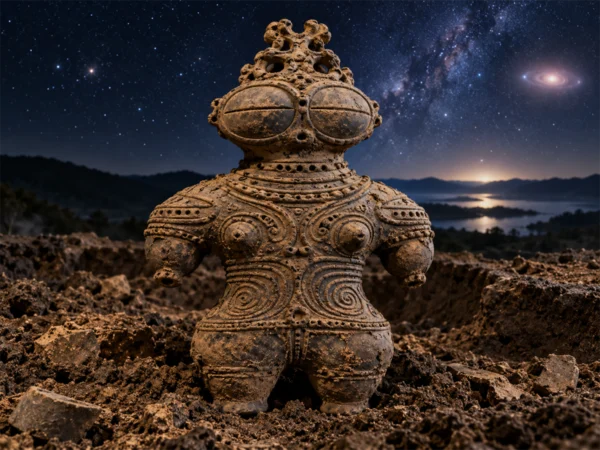
What are shakoki dogu?
Shakoki dogu are clay figurines made mainly in the Tohoku region in the final Jomon period (about 3,000 to 2,300 years ago). The most famous was excavated at the Kamegaoka site in Tsugaru, Aomori Prefecture; it is designated an Important Cultural Property of Japan and held at the Tokyo National Museum.
Where the name comes from
The name comes from the large horizontal eyes that cover most of the face, which resemble the shakoki (snow goggles) used by Arctic peoples to block the glare of snow. In reality, they are thought to be closed eyes or exaggerated depictions of eyes.
The alien theory
Because the swollen bodies and distinctive patterns look like spacesuits and helmets, writers abroad and others proposed from around the 1960s that they “depict aliens who visited the Earth in ancient times,” and the theory became widely known in Japan too. Archaeologically, they are thought to be ritual objects for praying for fertility, safe childbirth and rebirth, and the alien theory has no scholarly basis. See also the ancient astronaut theory.