Takeuchi Documents (Takeuchi Monjo)

竹内文書

Ancient Civilizations

Ancient documents said to have been handed down in the Takeuchi family of Ibaraki Prefecture. They describe super-ancient dynasties before Emperor Jimmu and a story that Christ died in Japan. Made public in 1928, they are considered modern forgeries.

Also known asTakeuchi Bunken, Takeuchi manuscripts, Amatsukyo documents
Era / first recorded1928 (made public)
OriginJapan
Related people
Stats
Rarity
Danger
Reality
Fame

Originally written in Japanese. 日本語版を読む (the Japanese page also has rankings and comments).

What are the Takeuchi Documents?

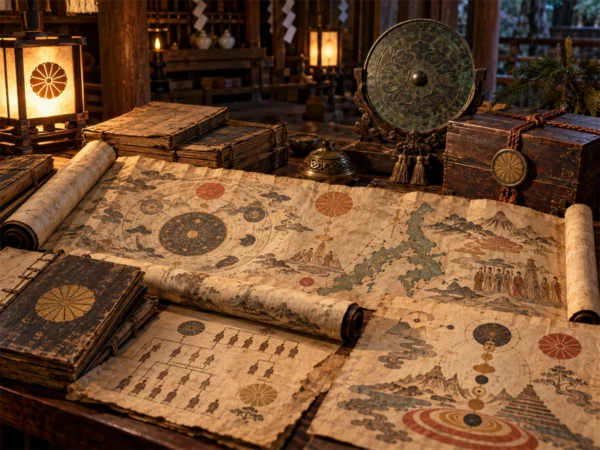
The Takeuchi Documents is the collective name for the ancient documents and sacred treasures made public in 1928 by Takeuchi Kiyomaro, head of the Koso Kotaijingu (Amatsukyo) religious group in Ibaraki Prefecture. Said to have been handed down in the Takeuchi family for generations, they drew attention for supposedly recording the super-ancient history of Japan.

What do they say?

The Takeuchi Documents claim that long before Emperor Jimmu there were super-ancient dynasties such as the “Ugayafukiaezu dynasty,” and that emperors traveled around the world in flying ships. They also stated that Moses, the Buddha and Christ had visited Japan. In 1935, a “Tomb of Christ” was said to have been found in Herai Village, Aomori Prefecture (today’s Shingo), based on the documents, and it remains a tourist spot where a Christ Festival is held.

Are the Takeuchi Documents genuine?

Before the war, Takeuchi Kiyomaro was tried for lese-majesty and other charges, but was ultimately acquitted. Meanwhile, in 1936 the philosopher Kano Kokichi published a paper criticizing them as forgeries made in modern times, based on their script and language. Most of the originals are said to have been destroyed during the war. Today historians regard them as forgeries, but they are still told of as a classic of super-ancient history romance.

Takeuchi Documents (Takeuchi Monjo): Legend & Sighting Locations

Please note Trespassing on private property or restricted areas is prohibited by law. Please be considerate of local residents.

Positions on the map are a rough guide to the area where a legend or sighting is set. Most pins are placed at representative points of a municipality or prefecture (outside Japan, a city position rounded to about 10 km, or the country), not at the exact place.
Municipality points: Geolonia address data (CC BY 4.0), based on the Address Base Registry (Digital Agency of Japan) / Country points: Natural Earth

Sources & References

  1. 天津教古文書の批判 (狩野亨吉, 1936)

Please note The contents of this site introduce legends, eyewitness accounts and theories; they do not guarantee that anything described is true. The stats are our own rough guide. Trespassing on private property or restricted areas is prohibited by law. Please be considerate of local residents.

Related Entries