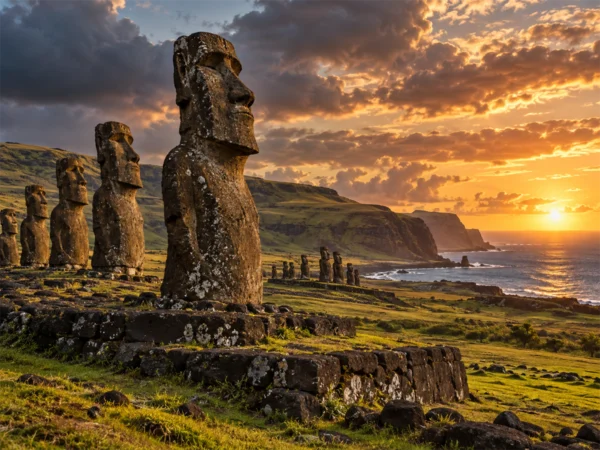
What are the moai?
The moai are giant stone statues of the upper human body on Easter Island (Rapa Nui in the local language), a Chilean island in the South Pacific. There are said to be about 900 of them, the largest over 10 meters tall and weighing more than 80 tonnes. The whole island was inscribed as a UNESCO World Heritage Site as Rapa Nui National Park in 1995.
Who made them, and why?
The moai were made by the ancestors of the Polynesian islanders who crossed the Pacific by canoe. Between around the 10th and 16th centuries, they were carved with stone tools from the volcanic tuff of the Rano Raraku crater in the east of the island.
The moai are thought to represent deceased chiefs and ancestors, protecting the villages with their spiritual power. Most stand on stone platforms called ahu with their backs to the sea, watching over the villages. The seven moai of Ahu Akivi, which face the sea, are a famous exception. Some moai wear red stone topknots called pukao, and some have eyes inlaid with white coral.
How were they moved? The “walking moai”
How the giant moai were moved from the quarry to coasts kilometers away was long a mystery. Island tradition says that the moai walked by themselves, and in 2012 researchers showed experimentally that a small team could “walk” an upright statue by rocking it from side to side with several ropes.
On the slopes of Rano Raraku, many unfinished moai remain, along with moai buried up to their heads. Excavations of these statues explain why “the moai have bodies” so often goes viral online.
The moai and the legend of Mu
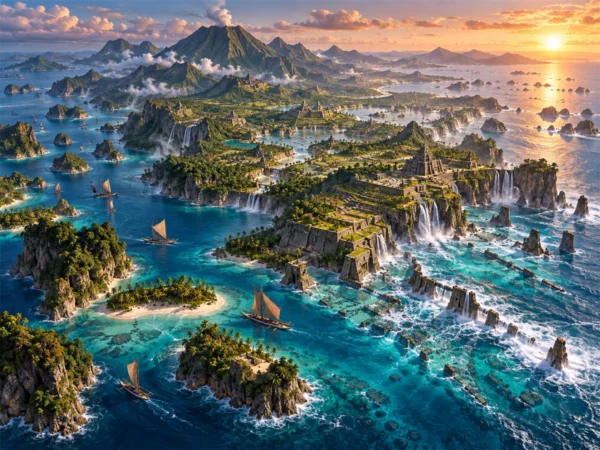
Because giant statues stand on such a remote island, the moai have long been linked with mysterious ancient civilizations. In the early 20th century, James Churchward claimed that Easter Island was a remnant of the sunken continent of Mu. The island’s undeciphered rongorongo script has deepened the mystery. Modern research, however, regards the moai as an achievement of the Polynesian people’s own culture. Together with Stonehenge, they are among the world’s most famous megalithic monuments.