What is Mohenjo-daro?
Mohenjo-daro is the ruin of an ancient city on the west bank of the Indus River in Sindh Province, southern Pakistan. It is the representative city of the Indus civilization, which flourished from around 2500 BC to around 1900 BC, and at its peak is estimated to have had tens of thousands of inhabitants. Excavations began in 1922, and it was inscribed as a UNESCO World Heritage site in 1980. Its name is said to mean “mound of the dead” in the local Sindhi language.
A planned city 4,500 years ago
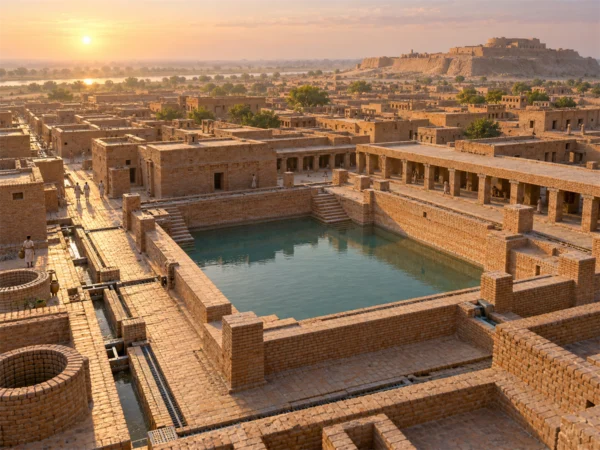
A major feature of Mohenjo-daro is that it was a carefully planned city. Main streets ran in a grid, and houses were built of standardized fired bricks. Many houses had wells, bathrooms and toilets, and wastewater flowed away through sewers built of brick.
On a raised area called the citadel was a waterproofed, pool-like “Great Bath,” thought to have been used for religious bathing. Remains of a large building thought to be a granary have also been found. Finds include a stone statue of a figure called the “Priest-King” and a small bronze figure known as the “Dancing Girl.”
The Indus script and the mysteries of Mohenjo-daro
Many small seals carved with animals and signs have been found at Mohenjo-daro. The Indus script on them consists mostly of short strings of signs, and no bilingual texts have been found, so it remains undeciphered. Another great mystery of the civilization is that no clear buildings demonstrating power, such as a royal palace or great temple, have been found.
Various theories explain the decline of the Indus civilization, such as changes in river courses, a drying climate and the decline of trade, but nothing is certain yet.
The ancient nuclear war theory
Mohenjo-daro is also known for the urban legend that it “was destroyed in an ancient nuclear war.” It is said that skeletons found at the site lay as if they had met sudden death, that glassy stones melted by intense heat were found, and that high radioactivity was detected, and these claims were linked with weapon descriptions in the Indian epic Mahabharata (the ancient nuclear war theory).
However, the skeletons are known to have been found in layers from different times and places, and did not die at once. There is also no reliable scholarly report of high radioactivity. The true value of Mohenjo-daro lies in the advanced city-building of people 4,500 years ago. Other famous ancient monuments include Stonehenge and the moai.